

Cap Rate, Cash Flow & ROI Guide for Toronto Condo Investors
Understanding the financial metrics of real estate investment is essential before committing capital to any Toronto property. Cap rate, cash flow, and total ROI are the three core measures investors use to evaluate rental properties — but they measure different things, and relying on any single metric in isolation gives an incomplete picture. This guide explains what each metric means, how to calculate it, what typical figures look like in the Toronto condo market, and how to use these numbers to make better investment decisions.
Capitalization Rate (Cap Rate)
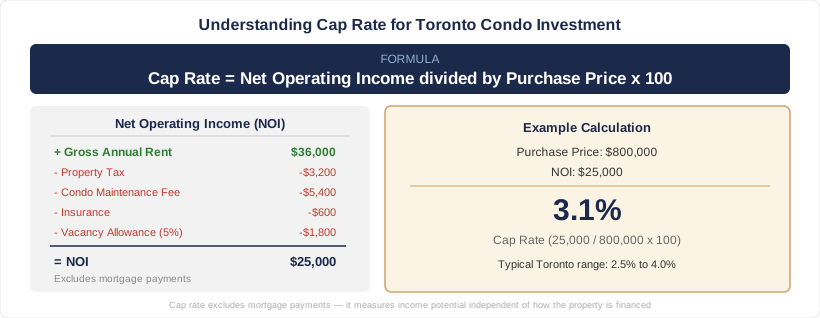
Cap rate measures a property's income-producing potential independent of how it's financed. It is calculated as Net Operating Income (NOI) divided by the property's current market value, expressed as a percentage.
Cap Rate = Net Operating Income ÷ Purchase Price × 100
Net Operating Income is gross annual rental income minus all operating expenses — including property taxes, insurance, maintenance fees, property management costs, and vacancy allowance — but before mortgage payments. Cap rate deliberately excludes financing so that different investors (with different mortgage situations) can compare properties on a consistent basis.
What Cap Rates Look Like in Toronto
Toronto condo cap rates are among the lowest of any major Canadian market, typically ranging from 2.5% to 4.0% for resale condos and slightly lower for premium new construction in high-demand nodes. This is a direct consequence of Toronto's high purchase prices relative to achievable rents. Investors accept low cap rates in Toronto for two reasons: strong appreciation expectations and the depth and stability of the rental market. A property with a 3% cap rate in Yonge-Eglinton is a different risk-reward profile than a 3% cap rate in a secondary market with no appreciation history.
Cash Flow
Cash flow is what you actually put in your pocket each month after every expense, including mortgage payments. Unlike cap rate, cash flow is specific to your financing situation.
Monthly Cash Flow = Gross Rental Income − (Mortgage Payment + Maintenance Fee + Property Tax + Insurance + Management Fee + Vacancy Allowance)
Cash Flow Reality in Toronto's Condo Market
In Toronto's current market, most condo investors run at near-neutral or mildly negative monthly cash flow — particularly for properties purchased with standard 20–25% down payments at current mortgage rates. Negative cash flow of $200–$500/month is not uncommon for newer buildings with higher maintenance fees and current interest rates. This does not necessarily make the investment bad — it means the return thesis depends more on appreciation than monthly income. Investors need to be honest about this distinction before purchasing.
Investors who entered the market prior to 2020 at lower purchase prices and have since seen significant rent increases (pre-construction buyers who locked in years ago, for example) often run at positive cash flow even at current rates. The entry point matters enormously.
Total Return on Investment (ROI)
Total ROI captures the full picture of what you've earned from a property — combining cash flow (positive or negative), principal paydown (the portion of each mortgage payment that reduces your balance), and appreciation (the increase in the property's market value). This is the metric that explains why investors accept negative short-term cash flow in a market like Toronto.
Calculating Total ROI
A simplified total return calculation for a Toronto condo might look like this: purchase at $750,000 with 20% down ($150,000 equity invested); property appreciates $50,000 over five years; tenant pays down $40,000 of mortgage principal; net cash flow is -$5,000 over five years. Total return before transaction costs: $50,000 + $40,000 − $5,000 = $85,000 on $150,000 invested, representing a 56% return on equity over five years (before taxes). This excludes transaction costs at both ends — which are significant — and assumes appreciation, which is not guaranteed.
Key Expenses Investors Often Underestimate
Vacancy allowance: plan for at least 4–6% of gross annual rent as a vacancy allowance, even in a tight market. Tenant turnover, renovation between tenants, and extended vacancy searches happen. Models that assume 100% occupancy are too optimistic.
Maintenance fee increases: condo maintenance fees increase every year, and in buildings with underfunded reserve funds, the increases can be substantial. Underwriting a purchase at today's maintenance fee without accounting for annual increases understates long-term costs.
Mortgage renewal risk: investors who purchased at lower rates and are approaching renewal face a payment shock that can shift a previously cash-flow-positive property into negative territory. This should be modelled before purchase at current market rates, not at the rate you happen to secure at purchase.
Capital expenditures: in-unit appliances, flooring, fixtures, and finishing refreshes between tenants are real costs not covered by the condo corporation. Budget $2,000–$5,000 every few years for in-unit capital expenditures depending on the unit's age and condition.
Frequently Asked Questions
What cap rate should I target in Toronto?
In Toronto's market, asking "what cap rate should I target" is a bit like asking what price you should pay for a property — it depends on your alternative uses of capital, your leverage, your appreciation expectations, and your risk tolerance. Most experienced Toronto investors model for 3–4% cap rates in the 416 and accept this as the market reality. If your thesis depends on a 6% cap rate in downtown Toronto, you will not find properties that support it at current prices.
Is it better to invest in a pre-construction condo or a resale rental?
Pre-construction offers potential appreciation during the construction period, deferred closing costs, and the ability to secure today's price for future delivery. Resale offers immediate rental income, certainty about the building's actual condition and management quality, and no occupancy fee risk. The right choice depends on your timeline, cash flow position, and appetite for the construction-period risks that pre-construction involves. See our dedicated Pre-Construction vs. Resale guide for a full comparison.
This guide is for general informational purposes and does not constitute financial, tax, or investment advice. Real estate investment involves risk, including the risk of capital loss. Always consult a licensed financial advisor, accountant, and real estate professional before making any investment decision.
Ready to Take the Next Step?
Create your free, secure account at www.VIPCondosToronto.net for full MLS access, real-time sold data, and VIP pre-construction pricing and floor plans — the same tools our team uses every day.
For personalized advice on your specific Toronto buying or selling situation, contact Frank Merigliano and the VIP Condos Toronto team directly:
Phone: 416-885-0172
Email: frank@vipcondostoronto.net
Web: www.VIPCondosToronto.net
Frank Merigliano, Team Leader / Sales Representative, VIP Condos Toronto, RE/MAX PREMIER INTERNATIONAL INC., Brokerage — licensed since 1993, with RE/MAX since 1995, and a Top 50 RE/MAX team in Canada since 2015.
Have questions?
Want to know more about Cap Rate, Cash Flow & ROI Guide for Toronto Condo Investors? Send me a message and I'll get back to you within 24 hours.