

Condo Board & Governance Guide for Toronto Owners & Buyers
When you buy a condo in Toronto, you're not just buying a unit — you're becoming a member of a condominium corporation, a legal entity that owns and manages the building's common elements on behalf of all unit owners. The condo corporation is governed by an elected board of directors made up of unit owners, and it operates within a framework established by Ontario's Condominium Act, 1998. Understanding how condo governance works — and what your rights are as an owner — is essential whether you're buying your first condo or managing a dispute with your existing board. This guide covers the structure of condo governance, what boards can and can't do, how to read financial documents, and what to do when things go wrong.
How Condo Corporations Are Structured
Every registered condominium in Ontario is a legal corporation under the Condominium Act. The corporation owns the common elements — everything outside the boundaries of individual units — and is responsible for managing, maintaining, and repairing those common elements on behalf of all owners. Individual unit owners pay monthly maintenance fees (common expenses) that fund the corporation's operating budget and contribute to the reserve fund.
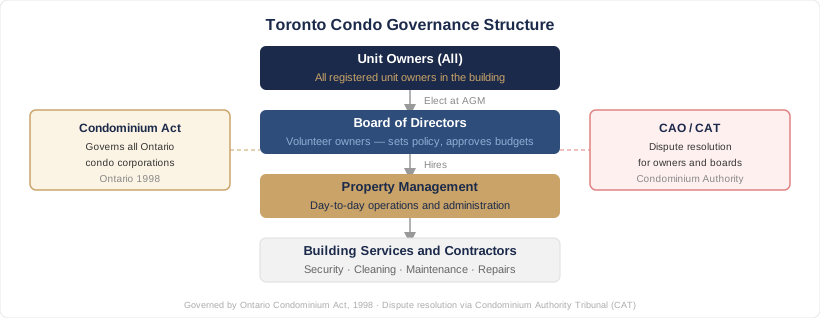
The corporation is governed by a board of directors elected by unit owners at an Annual General Meeting (AGM). Board members are volunteers — they are owners themselves — and they hire a property management company (or self-manage) to handle day-to-day operations. The board approves budgets, sets policies, authorizes major expenditures, and represents the corporation in legal matters.
The Key Governing Documents
Declaration: the founding document of the condominium, registered with the Land Registry Office when the building is first created. The declaration establishes unit boundaries, common element definitions, maintenance responsibility allocations, and any usage restrictions. Changes to the declaration typically require a very high threshold of owner approval (often 80–90% of all unit owners).
By-Laws: the rules governing how the corporation operates internally — including board meeting procedures, election rules, quorum requirements, and the process for amending the by-laws themselves. Changes to by-laws require a majority vote of unit owners.
Rules: the day-to-day operational policies of the building — pet policies, noise restrictions, moving hour restrictions, common element usage rules, and guest parking policies. Rules can generally be amended by a board decision alone (with proper notice to owners), though owners can challenge rules they believe are unreasonable.
Status Certificate: the document you review when buying a resale condo — it includes the current financial statements, reserve fund balance, maintenance fee amount, any special assessments, pending litigation, and copies of the key governing documents. See our dedicated Status Certificate Guide for a full breakdown.
The Reserve Fund: What It Is and Why It Matters
The reserve fund is the condo corporation's savings account for major capital expenditures — roof replacement, elevator modernization, underground garage waterproofing, window replacement, and other large-scale repairs that occur on long cycles but cost significant sums when they arrive. Ontario law requires all condo corporations to commission a reserve fund study at regular intervals, which estimates the cost and timing of future capital expenditures and sets a recommended contribution schedule to ensure the fund is adequately funded when those costs arise.
A well-funded reserve fund is one of the most important indicators of a well-run building. When reserve funds are under-funded — as is common in buildings that kept maintenance fees artificially low for years — the corporation must either raise fees significantly, levy a special assessment, or borrow to cover major repairs. All of these outcomes are negative for owners.
Special Assessments: What They Are and How to Spot the Risk
A special assessment is a one-time charge levied against all unit owners when the reserve fund or operating fund has insufficient money to cover a required expenditure. Special assessments can range from a few hundred dollars to tens of thousands per unit, depending on the scope of the required work and the size of the reserve fund shortfall.
When buying a resale condo, the status certificate will disclose any existing or pending special assessments. But it won't necessarily predict future ones — that requires reading the reserve fund study to assess whether the current contribution schedule is sufficient for anticipated upcoming expenditures. This is one reason having a lawyer review the status certificate (not just the buyer) is strongly recommended: a lawyer experienced in condo purchases can identify whether a building's reserve fund position looks healthy or concerning relative to its stated study.
Your Rights as a Unit Owner
Right to attend and vote at the AGM: all unit owners are entitled to attend the Annual General Meeting, participate in discussion, and vote on matters requiring owner approval — including board elections, by-law amendments, and decisions requiring a requisitioned meeting.
Right to request a requisitioned meeting: if enough unit owners (typically 15% of owners) sign a requisition, the board is required to call a special meeting. This mechanism exists to allow owners to address concerns, remove board members, or vote on matters the board hasn't addressed.
Right to access records: under the Condominium Act, owners have the right to inspect and obtain copies of many of the corporation's records — including meeting minutes, financial statements, and contracts. Boards that habitually refuse legitimate record requests may be acting in violation of the Act.
Right to mediation and arbitration: Ontario's Condominium Authority of Ontario (CAO) and Condominium Authority Tribunal (CAT) provide dispute resolution mechanisms for owners and corporations in conflict — covering issues from rule enforcement to records access to noise disputes.
Frequently Asked Questions
What can I do if I think the condo board is acting improperly?
Start by reviewing the governing documents to confirm whether the board's action falls within or outside its authority. Then consider: attending the AGM and raising the issue formally; requesting relevant records to document the concern; consulting a condo lawyer; or filing with the Condominium Authority Tribunal for disputes that fall within the CAT's jurisdiction. The CAO also provides resources and guidance for owners navigating governance disputes.
Can the condo board evict me from my unit?
No. The condo corporation does not own your unit and cannot evict you from it. However, the corporation can take legal action to enforce compliance with the declaration, by-laws, or rules — including seeking an injunction through the courts or, in serious cases of persistent non-compliance, pursuing a court order requiring you to sell the unit. These are extraordinary remedies rarely used in practice.
What should I look for in the reserve fund study before buying a condo?
The key indicators are: whether the fund is currently adequately funded relative to the study's recommendations; what major expenditures are anticipated in the next 5–10 years and whether the current contribution schedule is projected to cover them; and whether there is a history of deferred maintenance that may mean upcoming costs are larger than the study anticipates. A real estate lawyer experienced in condo purchases can help you interpret what you're reading.
Can I run for the condo board myself?
Yes. Any unit owner in good standing (current on maintenance fees, no unresolved compliance issues) is generally eligible to stand for election to the board at the AGM. Board participation is one of the most direct ways owners can influence how their building is managed. It is volunteer work — time-consuming at times — but can be genuinely impactful in a building where you plan to own long-term.
This guide is for general informational purposes and does not constitute legal, financial, or tax advice. Always confirm current rules and rights with a real estate lawyer experienced in Ontario condominium law before taking any action related to a governance dispute.
Ready to Take the Next Step?
Create your free, secure account at www.VIPCondosToronto.net for full MLS access, real-time sold data, and VIP pre-construction pricing and floor plans — the same tools our team uses every day.
For personalized advice on your specific Toronto buying or selling situation, contact Frank Merigliano and the VIP Condos Toronto team directly:
Phone: 416-885-0172
Email: frank@vipcondostoronto.net
Web: www.VIPCondosToronto.net
Frank Merigliano, Team Leader / Sales Representative, VIP Condos Toronto, RE/MAX PREMIER INTERNATIONAL INC., Brokerage — licensed since 1993, with RE/MAX since 1995, and a Top 50 RE/MAX team in Canada since 2015.
Have questions?
Want to know more about Condo Board & Governance Guide for Toronto Owners & Buyers? Send me a message and I'll get back to you within 24 hours.