

Condo Insurance Guide for Toronto Unit Owners
Many Toronto condo buyers assume their building's insurance policy covers everything — and find out too late that it doesn't. The relationship between the condo corporation's master policy and your individual unit owner's policy is one of the most misunderstood aspects of condo ownership. Getting it wrong can leave you personally on the hook for thousands of dollars in damages from a leak, fire, or other incident that you expected to be covered. This guide explains how condo insurance works in Ontario, what the corporation covers versus what you need to cover yourself, and what to look for when selecting your own policy.
The Corporation's Master Policy vs. Your Unit Owner Policy
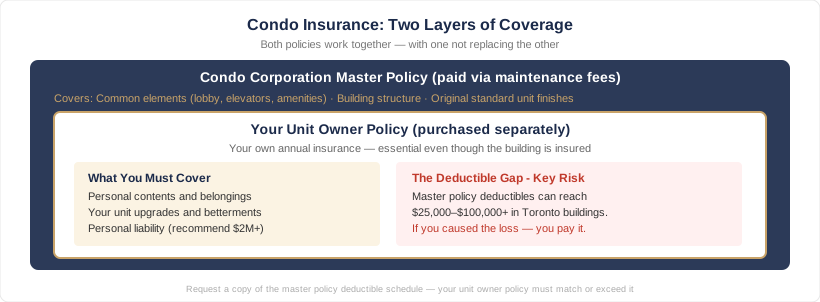
Every registered condominium corporation in Ontario is required by the Condominium Act to insure the common elements and units as built — meaning the building's structure, hallways, lobby, amenities, and the original standard finishes within each unit. This is the master policy, and it is paid for through your monthly maintenance fees.
What the master policy typically does not cover:
Your personal contents: furniture, electronics, clothing, appliances, and other personal belongings are not covered under the master policy. If a pipe bursts and destroys your furniture, the corporation's insurance will not replace it.
Upgrades and betterments: if you upgraded from the builder's standard finishes — better flooring, custom cabinetry, upgraded countertops — the master policy typically only covers the cost to restore the unit to original standard finish. Your upgrades are your liability.
Your personal liability: if you (or a guest) cause damage to another unit or to a common element — say, an overflowing bathtub that damages the unit below — you may be personally liable for the cost of remediation. Without your own liability coverage, that cost comes out of pocket.
Your deductible contribution: many condo corporation master policies now carry deductibles of $10,000–$100,000 or more, particularly for water damage claims (which are the most common and most expensive claim type in Toronto condos). Ontario's Condominium Act allows corporations to pass the deductible cost back to the unit owner who caused the loss. If you're at fault for a water leak with a $25,000 master policy deductible, you are responsible for that $25,000.
What a Unit Owner's Condo Policy Covers
A standard unit owner's condo insurance policy (sometimes called "condo unit owner's insurance" or "HO-6 equivalent" in industry terminology) typically includes:
Contents coverage: your personal property inside the unit — furniture, electronics, clothing, appliances, and valuables (subject to sublimits for jewelry, art, etc.).
Betterments and improvements: coverage for the cost of restoring your unit upgrades above the standard finish level, in the event of an insured loss.
Personal liability: protection against claims by third parties (other owners, guests, the corporation) for bodily injury or property damage you accidentally cause. Standard coverage is typically $1–$2 million; consider higher limits if you have significant assets to protect.
Loss assessment coverage: coverage for your share of a special assessment levied by the corporation to cover a loss that exceeded the master policy limits or deductible, up to the policy's stated limit. This is critical — ensure your policy includes meaningful loss assessment coverage (at least $50,000–$100,000 is advisable given Toronto building deductible levels).
Additional living expenses: if your unit is rendered uninhabitable by an insured loss, this covers the cost of temporary accommodation while repairs are completed.
Understanding the Corporation's Deductible Exposure
The deductible issue deserves special emphasis because it catches many Toronto condo owners off guard. As buildings age and water damage claims accumulate, insurers respond by dramatically increasing deductibles on master policies — particularly for water and sewer backup claims. It is not unusual for a Toronto condo corporation's master policy water damage deductible to be $25,000, $50,000, or higher.
Under Ontario's Condominium Act, corporations can include a provision in their declaration passing the deductible cost back to the unit owner responsible for the claim. Before purchasing in any building, ask to see the current master policy's deductible schedule — and make sure your own unit owner's policy includes a matching (or higher) deductible reimbursement provision.
Insurance Considerations for Rental Investors
If you own a Toronto condo as a rental property, a standard unit owner's policy is likely insufficient. Rental (or landlord) coverage typically requires a specific policy endorsement or a separate landlord policy that covers: loss of rental income if the unit is uninhabitable after a covered loss; any liability arising from the tenant's use of the unit; and property damage caused by the tenant. Standard owner-occupant policies often exclude or limit claims that arise from a tenanted unit.
Frequently Asked Questions
Do I need to buy my own condo insurance even though the building is insured?
Yes. The building's master policy does not protect your contents, your upgrades, or your personal liability. It also does not cover your exposure to the master policy's deductible. Every unit owner in Toronto should carry their own unit owner's policy — it is not expensive relative to the protection it provides, and the alternative (being uninsured for a major water loss) can be financially devastating.
How much condo insurance do I need?
At minimum: contents coverage at full replacement value of your possessions; betterments coverage sufficient to restore your upgrades; $2 million personal liability; and loss assessment coverage of at least $50,000–$100,000. Ask your insurer to review the building's current master policy deductible schedule and ensure your policy addresses it specifically.
How do I find out what the corporation's master policy covers?
Request a copy of the master policy from the property management company or condo board. This is a document you are entitled to as a unit owner under the Condominium Act. If you're buying a resale condo, this information is typically included in the status certificate package — your lawyer can review it as part of the status certificate review process.
This guide is for general informational purposes and does not constitute insurance advice. Coverage needs vary based on individual circumstances — always consult a licensed insurance broker to review your specific situation before purchasing or modifying any insurance policy.
Ready to Take the Next Step?
Create your free, secure account at www.VIPCondosToronto.net for full MLS access, real-time sold data, and VIP pre-construction pricing and floor plans — the same tools our team uses every day.
For personalized advice on your specific Toronto buying or selling situation, contact Frank Merigliano and the VIP Condos Toronto team directly:
Phone: 416-885-0172
Email: frank@vipcondostoronto.net
Web: www.VIPCondosToronto.net
Frank Merigliano, Team Leader / Sales Representative, VIP Condos Toronto, RE/MAX PREMIER INTERNATIONAL INC., Brokerage — licensed since 1993, with RE/MAX since 1995, and a Top 50 RE/MAX team in Canada since 2015.
Have questions?
Want to know more about Condo Insurance Guide for Toronto Unit Owners? Send me a message and I'll get back to you within 24 hours.