
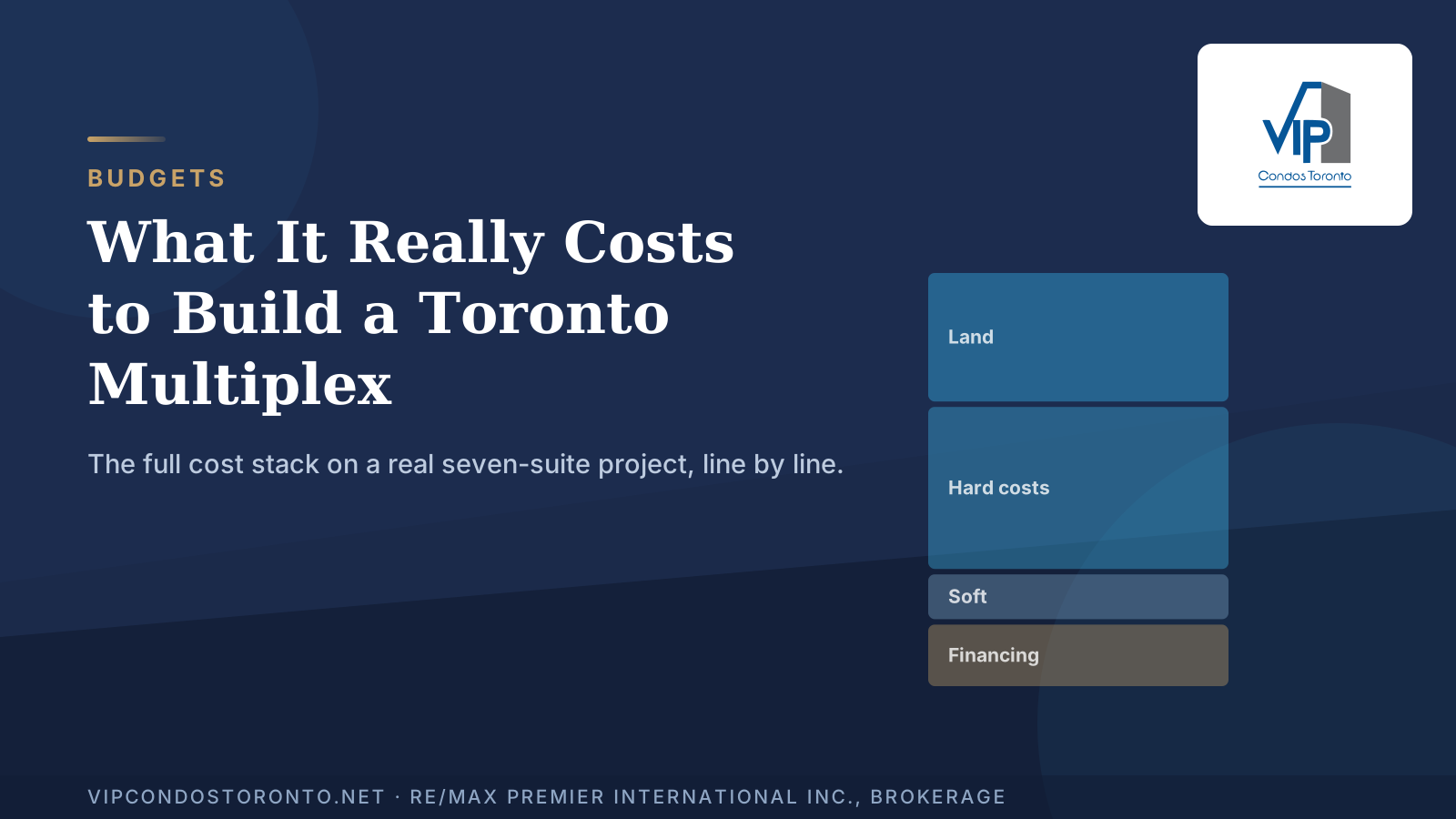
Most multiplex cost articles give you a per-square-foot range and stop. That range is the least useful number in the exercise, because hard costs are only about 57% of what you will actually spend.
So here is a complete budget from a real seven-suite Toronto project now in planning with one of our vetted general contractors. Six units in the main building plus a garden suite, on a flat 55' × 132' lot with minimal trees. The figures are the contractor's, under a fixed-price build contract covering all hard and soft costs including construction management.
We have not named the address. The numbers are the point.
The benchmark, and where it is heading
Per the Altus Group 2026 Canadian Cost Guide, Toronto and GTA hard-cost ranges:
| Hard construction cost, $ per square foot | |
| Wood-framed residential, up to 6 storeys — the multiplex benchmark | |
| $210–$330 | |
| 3-storey stacked townhouse | |
| $180–$270 | |
| Row townhouses, unfinished basement | |
| $155–$265 | |
| Single-family, unfinished basement | |
| $150–$275 | |
| Altus Group 2026 Canadian Cost Guide, as reported by Precedent Developments. Hard costs only — excludes land, soft costs, financing, development charges and other ancillary expenses. | |
The $210–$330 band is the right benchmark for a new-build Toronto fourplex or sixplex. Note how wide it is. A $120 spread on 8,800 square feet is more than a million dollars — which tells you that "what does a multiplex cost per foot" is a question with no useful answer until someone has looked at your site, your finish level and your unit mix.
2026 is a good year to be the one buying construction
Altus reports Toronto construction costs stabilized through 2025 and that residential building types — low-rise, mid-rise and high-rise — have been declining steadily over the past year, with pricing at or approaching the most affordable levels in three to five years.
The drivers are worth understanding, because they tell you how long this lasts:
Competitive bidding from trades and suppliers, because fewer projects are starting
Sharp decreases in concrete formwork, earthworks, shoring and windows
Flattened mechanical and electrical pricing
Largely flat labour costs
Altus describes 2026 as the best time to start new construction projects in Toronto. That is a cyclical statement, not a permanent one. When starts recover, trade pricing recovers with them.
The full budget: seven suites
Approximately 8,800 square feet across six main-building suites plus a two-level garden suite. Unit mix: four three-bedroom suites at roughly 1,100 sq ft, two four-bedroom two-level uppers at roughly 1,650 sq ft, and a three-bedroom garden suite at roughly 1,050 sq ft. Side private drive aisle to rear parking, seven spaces.
| Line | Amount | Share | What is in it |
|---|---|---|---|
| Lot acquisition | $1,325,000 | 32% | Purchase price, closing costs, land transfer tax |
| Hard costs | $2,350,000 | 57% | Demolition, excavation, structure, envelope, mechanical, electrical, finishes, site work |
| Soft costs | $250,000 | 6% | Architectural, engineering, studies, reports, surveys, permits, office operations |
| Financing costs | $175,000 | 4% | Construction line interest, lender fees, interest reserve |
| Total | $4,100,000 | 100% | ≈ $466 per sq ft all-in |
Two observations.
Hard costs land at roughly $267 per square foot — squarely inside the Altus band, toward the middle. This is a fixed-price contract from a builder who does multiplexes repeatedly, using common plans and standing crews. That repetition is where the efficiency comes from.
The all-in number is $466, not $267. Land is a third of the project. If you already own the lot, your number looks entirely different — and the deal is usually far stronger, because the largest line is already paid for at a historic basis.
The line that is not there
Development charges. On a six-unit building, units two through six now attract zero, following Council's July 2025 decision. Applying the City's published rate for multiples with two or more bedrooms, that is roughly $570,000 to $590,000 that would have been payable before that vote.
That single change is worth about 14% of this entire project budget. It is the reason multiplex arithmetic works in 2026 and did not in 2024.
What it is worth when it is finished
| Stabilized | Amount | Basis |
|---|---|---|
| Annual gross rental income | $318,400 | 4 suites at $3,300/mo, 3 at $4,250/mo, plus parking and utilities |
| Operating expenses | $63,700 | 20% of gross, including a vacancy allowance |
| Net operating income | $254,700 | After property tax, insurance, maintenance |
| Stabilized valuation | $5,420,000 | 4.7% cap rate |
| Equity created | $1,320,000 | Value less total cost |
CBRE's Q2 2026 Toronto range for new-construction multifamily is 4.00% to 4.75%. A 4.7% cap sits at the conservative end of that band, which is the right place to underwrite from.
Then the capital comes back
| Takeout and operation | Amount |
|---|---|
| CMHC takeout mortgage (95% of cost, before the insurance premium added to principal) | $3,895,000 |
| Capital returned after the construction line is repaid | $995,000 (≈ 83%) |
| Annual mortgage payment (40-year amortization, 3.95%, insurance in debt) | $204,540 |
| Estimated free cash flow, year one | $50,160 |
| Debt service coverage ratio | 1.245 (CMHC minimum 1.10) |
This is the mechanic that makes multiplex development repeatable. Most of the equity comes back out at refinancing, the asset keeps producing, and the same capital can fund the next project. Over a five-year hold with 3% NOI growth and roughly $250,000 of principal paid down, the contractor forecasts a valuation around $6.56M and equity of about $2.68M.
Five ways multiplex budgets go wrong
1. Underwriting on face rents
This is the big one in 2026. Urbanation reports new GTHA purpose-built rental achieving face rents of $4.05 per square foot but net rents after incentives of $3.51 — a discount of roughly $377 per month per unit. A pro forma built on asking rents overstates revenue by about 12%.
Worse, there are three different Toronto rent universes and mixing them is a fast route to a wrong number:
| Source | What it measures | Example |
|---|---|---|
| CMHC Rental Market Survey | Occupied purpose-built stock, including sitting tenants under rent control | 1BR $1,761 (Oct 2025 survey) |
| TRREB | Condo apartments leased through MLS | 1BR $2,273, 2BR $3,013 (Q2 2026) |
| Urbanation | New GTHA purpose-built rental — your actual competition | $4.05/sq ft face, $3.51 net (Q2 2026) |
For a new multiplex, the Urbanation net figure is the honest one. The CMHC average is a different universe with a different vintage.
2. Forgetting that vacancy is real right now
CMHC's October 2025 survey put Toronto purpose-built rental vacancy at 3.0%. Urbanation, tracking new and recent GTHA purpose-built rental in Q2 2026, reports 6.8% in stabilized buildings and 12.4% including buildings still in lease-up.
Those are not contradictory — they measure different stock. But a new multiplex competes with the new cohort, not with the 1970s stock. Underwrite lease-up accordingly, and budget an interest reserve that survives a slower absorption than you hope for.
3. Treating soft costs as a rounding error
In this budget, soft costs are 6% of project cost. On a project with a variance application, a difficult site, a heritage overlay or conservation authority involvement, they climb quickly. We could not find any authoritative published Toronto benchmark for soft cost percentages on small multiplex projects — anyone quoting you a precise industry figure is quoting a guess. Get a line-item estimate from a consultant who has done it.
4. Ignoring the bedroom cap at design stage
Three bedrooms per unit in a three-or-more-unit building. A sixplex is capped at eighteen bedrooms. If your rent assumptions depend on four-bedroom suites throughout, the design will not pass — and you will find that out after paying for it.
5. Living in one of the units
The federal purpose-built rental HST rebate requires at least 90% of units to be held for eligible long-term leasing. Owner-occupying one unit of a fourplex leaves 75%; of a sixplex, 83%. Either way, the rebate is lost. On a $4M project that is a very expensive apartment.
How VIP Condos Toronto helps close the gap
We are not the builder and we are not the general partner. We are the brokerage that has done the vetting, and that is the value we bring to this.
Our bench of contractors and consultants is pre-vetted for the thing that actually matters: whether they build multiplexes as their core business, repeatedly, with standing crews and common plans — or whether yours would be their first. One GP corporation we work with is operated by a principal with more than thirty years of construction and development management experience, whose related entities have delivered over three million square feet and more than $5 billion of development value, and which is now structured as a vertically integrated operation dedicated to multiplex projects: planning, development, financing, construction, lease-up, stabilization, operation and sale.
We do not publish our partners' corporate names here. If you are weighing a project and want to know exactly who you would be building with — the principals, the completed projects and the references — contact Frank Merigliano directly at 416-885-0172 or frank@vipcondostoronto.net and we will make the introduction.
We introduce clients into that bench either as 100% owners with a turnkey fixed-price contract, or as limited partners in a GP/LP structure. We will tell you honestly which one fits your situation, including when the answer is that neither does yet.
Related reading: 100% Ownership or GP/LP Partner? and Toronto's Multiplex Playbook for 2026.
Frequently Asked Questions
Is it cheaper to convert an existing house than to build new?
Often, and roughly three-quarters of Toronto's multiplex permits since 2023 have been conversions rather than new builds. A conversion avoids demolition and can reuse foundations and services. It also inherits whatever is wrong with the existing structure, and rarely achieves the unit count or the efficiency of a purpose-designed new build. It is a site-by-site answer.
How long does a build take?
On this project the contractor forecasts 10 to 12 months from lot closing to stabilization. There is no published City statistic for permit-to-occupancy on this building type — anyone quoting one is quoting their own experience. Ours is that site conditions and whether a variance is needed drive the timeline more than anything else.
What contingency should I carry?
A fixed-price contract transfers most construction cost risk to the builder, which is precisely why we prefer it on these projects. You still need contingency for site surprises, permit conditions and lease-up timing. Discuss the number with your lender — they will have a view, and it is usually the right one.
Do these numbers work on a smaller lot?
Not automatically. This budget reflects a 55' frontage on a 132' depth, which comfortably supports six units plus a garden suite within the height and depth envelopes. Narrower lots produce fewer or smaller units against a largely fixed set of site and soft costs, so the per-unit economics tighten. Feasibility on your specific lot is the first conversation, not the last.
This guide is for general informational purposes and does not constitute legal, financial, or tax advice. The project figures shown are one contractor's forecast for one specific site and are illustrative only; they are not a projection of returns on any other project, not a guarantee, and not an offer to sell securities. Every situation is different — always consult a licensed real estate professional, lawyer, and tax advisor before making any decisions.
Ready to Take the Next Step?
Create your free, secure account at www.VIPCondosToronto.net for full MLS access, real-time sold data, and VIP pre-construction pricing and floor plans — the same tools our team uses every day.
For personalized advice on your specific Toronto buying or selling situation, contact Frank Merigliano and the VIP Condos Toronto team directly:
Phone: 416-885-0172
Email: frank@vipcondostoronto.net
Web: www.VIPCondosToronto.net
Frank Merigliano, Team Leader / Sales Representative, VIP Condos Toronto, RE/MAX PREMIER INTERNATIONAL INC., Brokerage — licensed since 1993, with RE/MAX since 1995, and a Top 50 RE/MAX team in Canada since 2015.
Sources: Altus Group, cost guide insights for 2026; Altus Group 2026 Canadian Cost Guide ranges, as reported by Precedent Developments; CBRE, Canadian Cap Rates & Investment Insights Q2 2026; Urbanation, GTHA rental market Q2 2026; CMHC, Rental Market Reports; TRREB, Rental Market Report; Toronto City Council item 2025.MM32.5 (development charge exemption); City of Toronto development charge rates; Canada Revenue Agency, Purpose-Built Rental Housing Rebate.
Have questions?
Want to know more about What It Really Costs to Build a Toronto Multiplex in 2026? Send me a message and I'll get back to you within 24 hours.