
Home Staging Guide for Toronto Sellers
This home staging guide for Toronto sellers covers why staging matters so much in the 416 resale market, the trade-offs between DIY and professional staging, room-by-room priorities, the differences between staging a condo and a house, and why professional photography and virtual tours are essential once your home is stage-ready.
Why Staging Matters in the 416 Resale Market
Toronto buyers do the vast majority of their initial shopping online, scrolling through dozens of listing photos before deciding which properties are worth an in-person showing. A cluttered, poorly lit, or overly personalized listing gets scrolled past; a clean, well-staged, well-photographed one earns a click and a booked showing. In a market where many 416 listings compete for the same pool of buyers — often within the same offer-date window — staging is one of the few variables fully within a seller's control that can meaningfully affect both showing volume and final sale price.
DIY Staging vs. Professional Staging
Sellers generally choose between three approaches:
DIY staging: decluttering, deep cleaning, depersonalizing, and rearranging your own furniture and decor. This costs little beyond your own time and is often sufficient for well-maintained, tastefully furnished homes, but it's easy to overlook flaws that buyers will notice immediately.
Partial / consultation staging: a professional stager visits, advises on what to remove, rearrange, or refresh, and may bring in a small number of accent pieces, while you do most of the physical work yourself. This typically falls in a moderate, lower-cost range compared to full staging.
Full professional staging: a stager furnishes some or all of the home with rented furniture and decor, often for vacant properties or homes with dated or sparse furnishings. This typically represents a higher cost, usually billed monthly for the rental furniture plus a setup fee, but tends to produce the strongest photos and showings for higher-end or vacant listings.
Costs vary widely by stager, property size, and how much existing furniture can be used versus rented, so treat any number you hear as a typical range to confirm with your own agent and a local stager — not a fixed quote. In most cases, the cost of staging is recovered through a faster sale and a stronger final price, particularly for vacant or awkwardly furnished properties.
Room-by-Room Staging Priorities
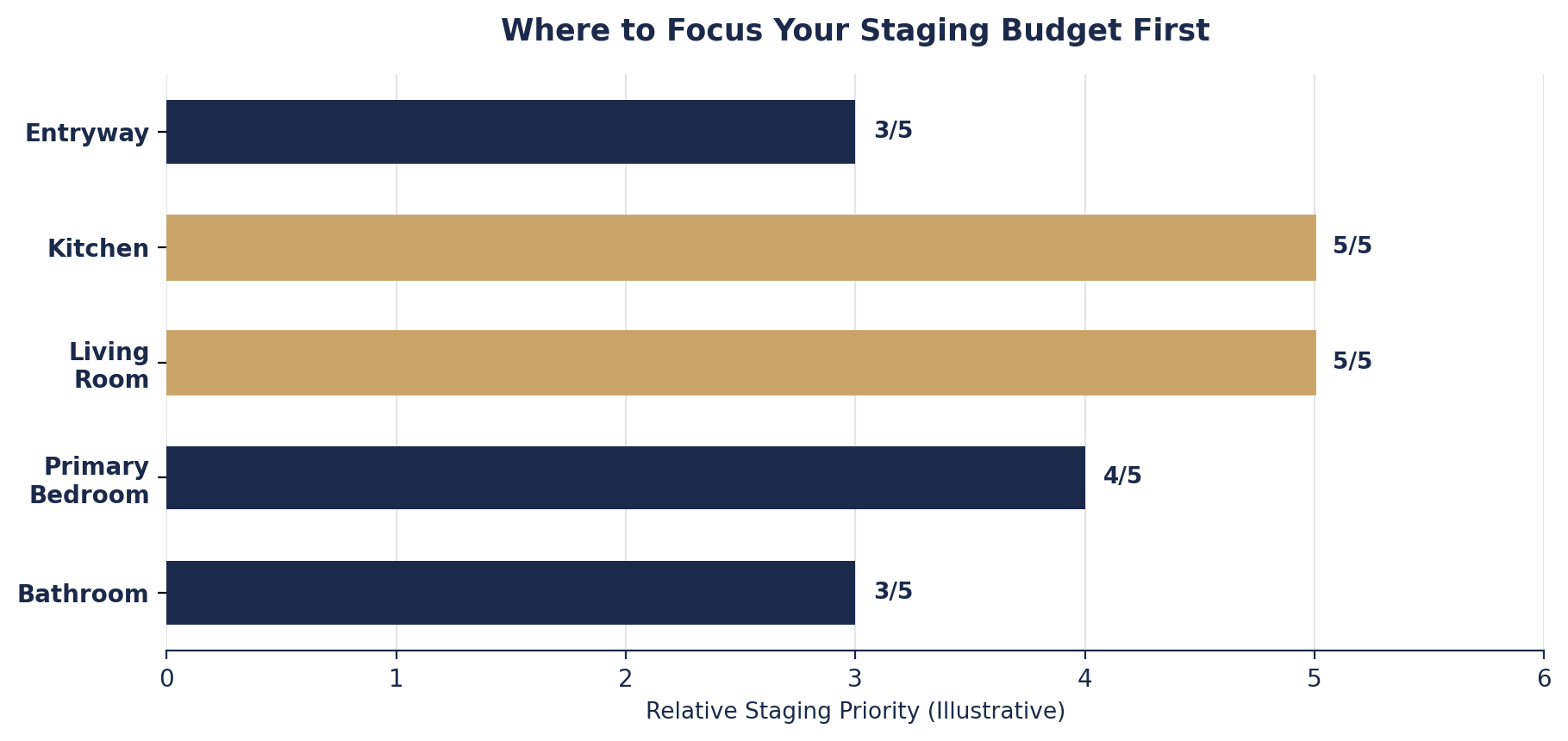
Not every room deserves equal staging effort. Focus your time and budget on the spaces that influence buyer perception the most:
Entryway: sets the first impression. Clear clutter, add a mirror or simple console, ensure lighting is bright and welcoming.
Kitchen: consistently one of the highest-impact rooms for buyers. Clear countertops completely, remove magnets and personal items from the fridge, and ensure the space feels move-in ready.
Living room: arrange furniture to create clear conversation areas and traffic flow, remove excess pieces to make the room feel larger, and add a few simple decor touches (cushions, a throw, fresh flowers).
Primary bedroom: should feel like a calm retreat — a neatly made bed with simple, neutral linens, cleared nightstands, and minimal personal photos.
Bathroom: deep clean grout and fixtures, remove personal toiletries from countertops, add fresh towels, and ensure mirrors are spotless.
Figure 1: Illustrative relative staging priority by room for a typical Toronto resale listing.
Staging Condos vs. Houses
Condo staging tends to focus on maximizing perceived space — smaller square footage means clutter and oversized furniture read as cramped much faster than in a house. Mirrors, light, neutral palettes, and multi-functional furniture all help a condo show larger. House staging has more square footage to manage, so consistency across multiple rooms and levels matters more, along with curb appeal for the exterior and entryway, which has no real equivalent in a condo sale.
Photography and Virtual Tours
Once your home is staged, professional photography and a video or virtual tour are essential, since the majority of buyer interest is generated online before a single in-person showing is booked. Wide-angle, well-lit daytime photography, a clean floor plan, and a walkthrough video or 3D virtual tour all help your listing stand out in crowded Toronto search results and reduce the number of unqualified showings, since buyers can rule properties in or out more confidently before booking a visit.
Decluttering and Depersonalizing
Before any staging furniture arrives, remove excess belongings, family photos, and personal collections. The goal is to let buyers picture themselves in the space rather than feeling like a guest in yours. A storage unit or pod rental for the duration of the listing is a worthwhile investment for most sellers, even those doing otherwise minimal staging.
Staging a Tenanted Sale (Brief)
Selling a property with a tenant in place adds complexity to staging, since you generally can't rearrange or replace a tenant's furniture and belongings without their cooperation. Where possible, work with the tenant on tidying common areas before showings, consider offering a modest incentive for their cooperation, and set realistic expectations with buyers that the listing photos reflect a lived-in, tenanted unit rather than a fully staged vacant one.
Frequently Asked Questions
Is professional staging worth the cost?
For most 416 listings, yes — particularly for vacant properties, higher-end listings, or homes with dated or sparse furnishings. The cost is typically recovered through faster sales and stronger offers, though the right level of staging (DIY, partial, or full) depends on your specific property and budget.
Do I need to stage every room?
No. Focus your effort and budget on high-impact rooms — kitchen, living room, primary bedroom, and entryway — rather than spreading staging thin across every closet and secondary room.
Should I stage a condo differently than a house?
Yes. Condo staging emphasizes maximizing perceived space with light, neutral tones, and appropriately scaled furniture, while house staging needs to maintain consistency across more rooms and levels and also account for curb appeal.
Can I sell a tenanted property without staging it?
Yes, many tenanted properties sell without full staging. Focus on decluttering common areas with the tenant's cooperation and set buyer expectations accordingly through your listing description and photos.
This guide is for general informational purposes and does not constitute legal, financial, or tax advice. Always confirm current rates and rules with a licensed mortgage professional, accountant, or real estate lawyer before making a decision.
Ready to Take the Next Step?
Create your free, secure account at www.VIPCondosToronto.net for full MLS access, real-time sold data, and (where relevant) VIP pre-construction pricing and floor plans — the same tools our team uses every day.
For personalized advice on your specific Toronto buying or selling situation, contact Frank Merigliano and the VIP Condos Toronto team directly:
Phone: 416-885-0172
Email: frank@vipcondostoronto.net
Web: www.VIPCondosToronto.net
Frank Merigliano, Team Leader / Sales Representative, VIP Condos Toronto, RE/MAX PREMIER INTERNATIONAL INC., Brokerage — licensed since 1993, with RE/MAX since 1995, and a Top 50 RE/MAX team in Canada since 2015.
Have questions?
Want to know more about Home Staging Guide for Toronto Sellers? Send me a message and I'll get back to you within 24 hours.