
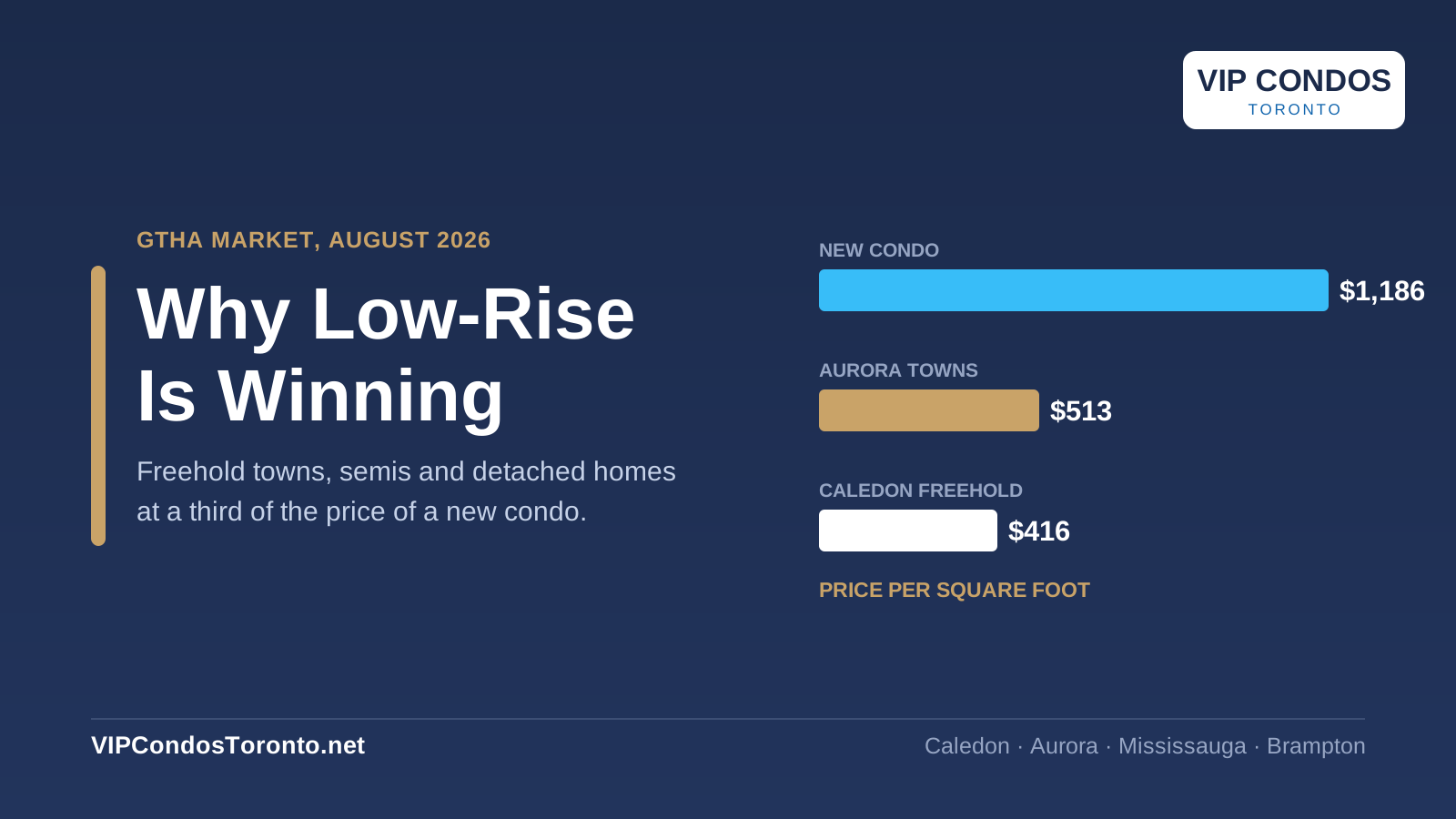
There is a number in this month's GTHA housing data that should change how you think about your next purchase. Developers are still asking an average of $1,186 per square foot for a new condo. Brand-new freehold homes, on land, forty minutes up the road, are selling at $416.
That is not a small gap. It is the difference between a 600-square-foot box with a monthly maintenance fee and a 2,000-square-foot house with a driveway — for money that is in the same conversation.
The gap, in one chart
| New GTHA condo — developer asking price | |
| $1,186 | |
| Wellington Place townhomes, Aurora | |
| $513 | |
| Windrose freehold homes, Caledon | |
| $416 | |
| Condo figure: Urbanation, Q2 2026. Low-rise figures: current builder price lists, August 2026. | |
The condo market's problem is now measurable
Three numbers tell the story of the 2026 GTHA condo market:
| What | Latest | Why it matters |
|---|---|---|
| Finished, unsold condo units in the GTHA | 5,001 | A record, up 68% in a year. These are built and empty. |
| Developer asking vs. resale, per sq ft | $1,186 vs. $830 | A 43% spread. Buyers are not closing that gap voluntarily. |
| Condo units cancelled since 2024 | 11,653 | Including a 58-storey Mississauga tower that refunded every deposit. |
Where the unsold condos actually are
The strain is worst outside Toronto, not in it. Toronto's Entertainment District — the market everyone complains about — is the healthiest of the three biggest problem nodes.
| Unsold new-condo units | |
| Downtown Hamilton | |
| 1,127 | |
| Vaughan Metropolitan Centre | |
| 966 | |
| Toronto Entertainment District | |
| 711 | |
| Share of that area's inventory still unsold | |
| Vaughan Metropolitan Centre | |
| 43% | |
| Downtown Hamilton | |
| 34% | |
| Toronto Entertainment District | |
| 27% | |
| Source: Zonda Urban, as reported by The Globe and Mail, August 17, 2026. | |
In the Vaughan Metropolitan Centre, 43% of everything built is still unsold — 966 units out of roughly 10,186 developed, 85% of which completed after 2020. That is a brand-new submarket absorbing its entire first generation of supply at once.
Why this happened
Dominic Tompa, president of Daniels Realty Corp., put it plainly: "You had a lot of projects that were sold between 2017 and 2022 and all having come to completion in the last 24 months to 30 months. You've got a lot of product that will just take time to absorb."
It is a completion wave meeting an investor base that has left the building. Condo rents in the affected nodes fell before prices did — average rent in the Vaughan Metropolitan Centre went from $4.06 per square foot in early 2025 to $3.52 a year later, roughly a 13% drop. When the rent stops covering the carry, the investor bid disappears. Everything after that is arithmetic.
Low-rise is not having the same problem
This is the part that gets lost when people say "the market is bad." The glut is a condo glut. Ground-related housing — freehold townhomes, semis and detached homes — has no comparable overhang, and it is behaving completely differently.
The clearest evidence is a project on Mississauga's waterfront. Caivan's stacked townhome release at Lakeview Village launched in June 2026 at $634 per square foot. Three weeks later it was priced at $674, up 6.3%. Today the builder is sold out. Over that exact same stretch, condo developers across the region were cutting asking prices and still could not move 5,001 finished units.
Three structural reasons, not just sentiment
1. You own the land. A freehold home has no monthly maintenance fee, no status certificate, no special assessment, and an appreciating asset underneath it rather than a share of a hallway. Over a 10-year hold, the maintenance fee alone on a typical condo runs into six figures.
2. Far less construction risk. High-rise lenders typically require about 70% of units sold before they fund construction. That threshold is why 11,653 units have been cancelled since 2024 — projects that could not get there simply never started. Low-rise phases are smaller, sell through faster, and get to shovels sooner.
3. The buyer base is end-users, not investors. Condos broke because the investor math broke. Families buying a home to live in do not exit when cap rates move. That is a more stable demand floor.
Six low-rise releases worth your attention right now
Selling now — live pricing and floor plans
Windrose at Caledon Trails — Caledon, by Laurier Homes and Yorkwood Homes. Freehold detached homes, semis and townhomes on 20', 25', 36', 38' and 42' lots at McLaughlin Road and Mayfield Road. Thirty-three plans from 1,540 to 3,500 square feet, occupancy 2027. From $679,900, or roughly $416 per square foot. Deposit is $120,000 spread over 180 days, and current incentives include capped development levies, a finished basement and free appliances.
Wellington Place by Arkfield — Aurora, at 200 Wellington Street West in King West. Two- and three-storey townhomes, 1,707 to 1,945 square feet, with a Walk Score of 99 and a Transit Score of 96 — better walkability than most downtown Toronto condo addresses, in a townhome. From $898,900, roughly $513 per square foot. Incentives include free air conditioning, free appliances, free assignment, capped maintenance and reduced development charges.
Launching this fall — register now
Cornerstone by Primont Homes — Northwest Brampton, in Heritage Heights at Mississauga Road and Wanless Drive. A master-planned community of three- to five-bedroom freehold townhomes and detached homes. Broker preview is September 16, 2026, broker signing day September 26, and the public grand opening October 3. Registration ahead of preview day is what determines who gets the good lots.
South Banks by OPUS Homes and South Banks by DECO Homes — a joint coastal townhome release from two builders inside Lakeview Village at 1110 Lakeshore Road East, Mississauga. Contemporary two-, three- and four-bedroom homes from the $500s: two-storey designs with rooftop terraces, underground parking and no below-grade living space, with waterfront, parks and promenade at the door. Early fall 2026 launch.
Already gone — and that is the point
Aura at Lakeview Village, Phase 2 — Caivan Communities' stacked townhomes at the same Lakeview Village address. Launched June 2026, priced up 6.3% within three weeks, and now sold out by the builder. Access today means assignments and final releases. It is the single best illustration of the divide: while condo inventory piles up, well-located low-rise is clearing at rising prices.
What I would actually do
If you are buying your first home or upgrading: look hard at low-rise before you look at pre-construction condos. The price per square foot is a third to a half, you get land, and the construction risk is materially lower. Get registered before launch day on anything you like — the best lots and the best pricing genuinely do go first.
If you own a GTHA condo: get a current, honest valuation before you make any decision. Resale in new buildings is trading near $830 per square foot. If you bought pre-construction in 2021 or 2022 and are closing soon, get an appraisal done before the closing date — units contracted near $1,250 per square foot appraising in the $760 to $900 range is the specific problem causing closing shortfalls right now, and it is only solvable with lead time.
If you are an investor: the condo rent floor may be forming — GTHA condo rents fell just 1.3% year over year in Q2 2026, the smallest decline in two years, and completions collapse after 2027. But "the bottom is near" and "this is the best risk-adjusted entry" are different statements. Right now, low-rise is the better one.
Frequently Asked Questions
Is it a bad time to buy a condo in Toronto?
It is a strong time to negotiate on one and a poor time to overpay for one. With 5,001 finished unsold units and developer asking prices 43% above comparable resale, buyers have more leverage than at any point in a decade — particularly on standing inventory. The mistake is paying a pre-construction price in a market where the finished product next door sells for a third less.
Why is low-rise cheaper per square foot than a condo?
High-rise construction costs far more per square foot to build — concrete, elevators, underground parking, extensive common elements — and those costs are carried in the price along with the amenity space you pay for but rarely use. Low-rise trades a central location for land and space. In today's market, that trade is unusually favourable.
What does "freehold" actually mean?
You own the home and the land it sits on outright, with no condominium corporation and no monthly maintenance fee. Some townhome communities are "common element condominium," where you own the home freehold but pay a small fee for shared roads or landscaping — always confirm which structure applies before you sign.
Is my deposit safe on a pre-construction low-rise home?
Deposits on new freehold homes in Ontario are protected by Tarion up to statutory limits, and condominium deposits are protected separately. Cancellation risk is about time and opportunity cost more than principal — the M6 buyers in Mississauga got every dollar back, but only after two and a half years. Smaller, faster low-rise phases reduce that exposure.
This article is for general informational purposes and does not constitute legal, financial, or tax advice. Every situation is different — always consult a licensed real estate professional, lawyer, and tax advisor before making any decisions. Pricing, sizes and incentives are as at August 2026 and are subject to change without notice. E.&O.E.
Ready to Take the Next Step?
Create your free, secure account at www.VIPCondosToronto.net for full MLS access, real-time sold data, and VIP pre-construction pricing and floor plans — the same tools our team uses every day.
For personalized advice on your specific Toronto buying or selling situation, contact Frank Merigliano and the VIP Condos Toronto team directly:
Phone: 416-885-0172
Email: frank@vipcondostoronto.net
Web: www.VIPCondosToronto.net
Frank Merigliano, Team Leader / Sales Representative, VIP Condos Toronto, RE/MAX PREMIER INTERNATIONAL INC., Brokerage — licensed since 1993, with RE/MAX since 1995, and a Top 50 RE/MAX team in Canada since 2015.
Sources: "Condo developers outside Toronto feeling the biggest strain from market's downturn, data show," The Globe and Mail, August 17, 2026 (unsold inventory data: Zonda Urban). Urbanation, Q2 2026 GTHA condominium market and rental market reports. Project details from current builder price lists and marketing materials, August 2026.
Have questions?
Want to know more about Why Low-Rise Homes Are Beating GTHA Condos Right Now — And Where the Unsold Condos Actually Are? Send me a message and I'll get back to you within 24 hours.