
Mortgage Pre-Approval & Financing Guide for Toronto Buyers
Mortgage pre-approval Toronto buyers complete before house hunting sets the foundation for the entire purchase: it confirms your budget, locks a rate hold, and signals to sellers that your offer is credible. This guide covers the mortgage stress test, insured vs. uninsured mortgages, the 30-year amortization option, fixed vs. variable rates, minimum down payment tiers, and what documents you'll need to get pre-approved.
Why Get Pre-Approved Before You Shop
A mortgage pre-approval is a lender's conditional commitment to lend you a certain amount, based on a review of your income, debts, credit, and down payment — subject to final underwriting and property appraisal once you have an accepted offer. Pre-approval matters for three reasons: it tells you your realistic price range before you fall in love with a property you can't afford, it typically locks a rate hold for 90-120 days protecting you if rates rise, and it makes your offers more credible to sellers and listing agents in a competitive 416 market where unconditional, well-financed offers tend to win.
The Mortgage Stress Test
Every mortgage applicant in Canada — whether insured or uninsured — must qualify using the mortgage stress test. Your qualifying rate is the greater of 5.25% or your actual contract rate plus 2 percentage points. This means even if your lender offers you a rate well below 5.25%, you must prove you could afford payments calculated at the higher stress-test rate, which reduces the maximum amount most buyers qualify to borrow compared to using the contract rate alone.
Insured vs. Uninsured Mortgages
Insured mortgages: apply when your down payment is less than 20% of the purchase price. The mortgage is insured by CMHC or a private insurer, which protects the lender if you default, and you pay a mortgage insurance premium (typically added to your mortgage balance). Insured mortgages are only available on homes priced at $1.5 million or less.
Uninsured (conventional) mortgages: apply when your down payment is 20% or more, or when the purchase price exceeds $1.5 million (which requires a minimum 20% down payment and disqualifies the purchase from mortgage insurance regardless of down payment size). No insurance premium applies, but you still must pass the same stress test.
The 30-Year Amortization Option
As of the December 2024 federal expansion, a 30-year amortization is now available on CMHC-insured mortgages for all first-time buyers and all buyers of newly built homes (not just first-time buyers, for new construction). This applies up to the insured mortgage price cap of $1.5 million. Stretching amortization from the traditional 25 years to 30 years lowers your monthly payment, which can help affordability, though it also means paying more interest over the life of the loan. Ask your mortgage professional whether you qualify for 30-year amortization based on your buyer profile and the property type.
Fixed vs. Variable Rate Mortgages
Fixed-rate mortgages: your interest rate is locked for the term (commonly 5 years), so your payment doesn't change regardless of what happens in the broader rate environment. This offers payment certainty, which many buyers value for budgeting.
Variable-rate mortgages: your rate floats with the lender's prime rate, so your payment (or the interest/principal split of a fixed payment, depending on the product) can change as rates move. Variable rates have historically started lower than fixed rates, but they carry more uncertainty over the term.
Both fixed and variable mortgage applicants must pass the same stress test described above. Your mortgage broker or lender can model out how each option performs under different rate scenarios for your specific budget.
Renewal Stress-Test Exemption
As of November 2024, borrowers who are simply switching lenders at mortgage renewal — without increasing the loan amount or extending the amortization — are exempt from re-qualifying under the stress test. This makes it easier to shop around for a better rate at renewal time without being penalized by stress-test math, as long as you're not taking out additional funds or changing the loan structure.
Minimum Down Payment by Price Tier
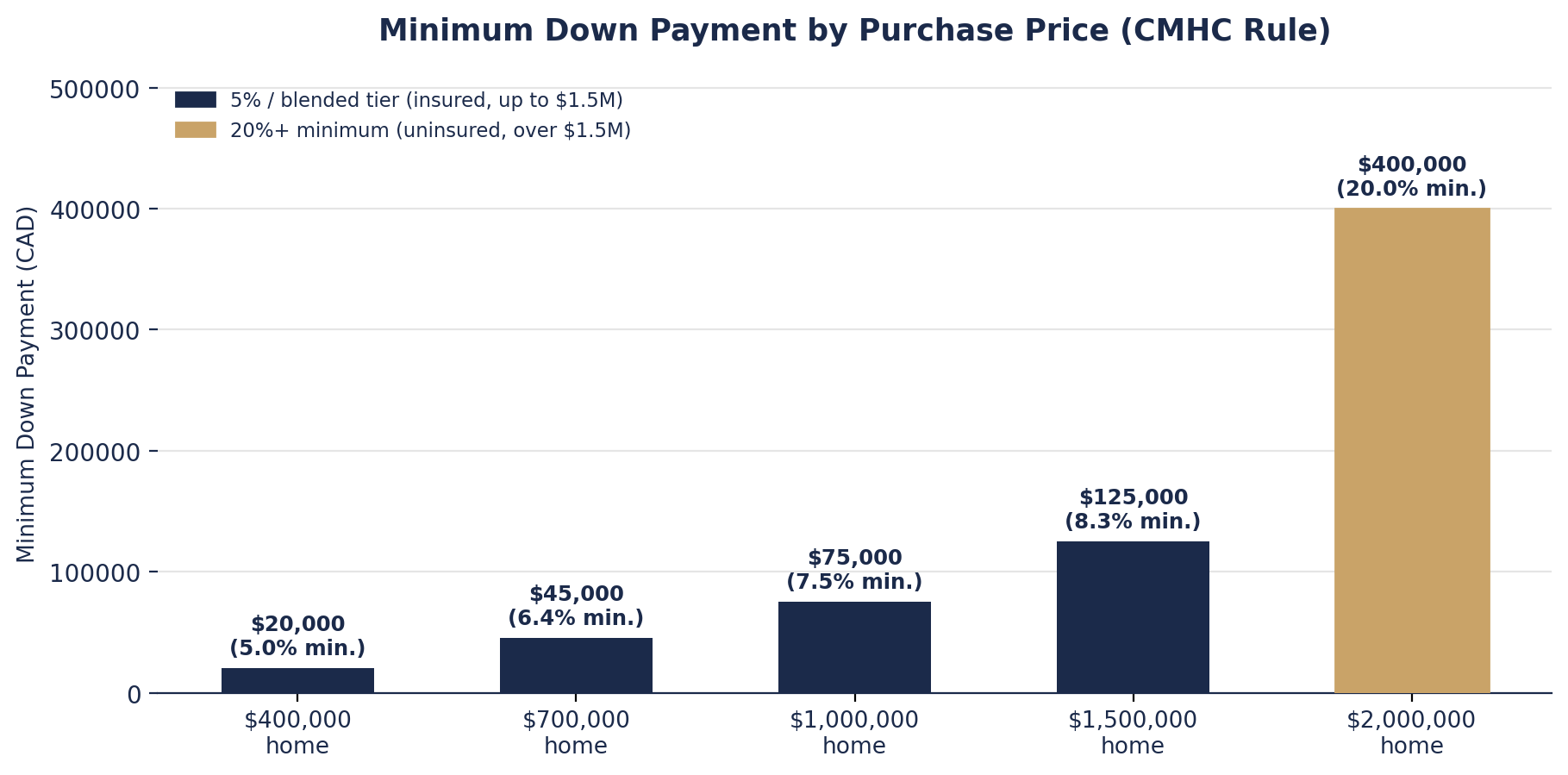
Canada's minimum down payment rule is tiered based on the purchase price:
Up to $500,000: minimum 5% down payment.
$500,000 to $1,500,000: 5% on the first $500,000, plus 10% on the portion of the price between $500,000 and $1,500,000.
Above $1,500,000: minimum 20% down payment, and the mortgage cannot be insured regardless of down payment size.
Figure 1: Illustrative minimum down payment by purchase price under the CMHC minimum down payment rule.
Documents Needed for Pre-Approval
Gather these documents before meeting with a lender or mortgage broker to speed up your pre-approval:
Frequently Asked Questions
What's the difference between pre-qualification and pre-approval?
Pre-qualification is a rough, often self-reported estimate of what you might afford. Pre-approval involves a lender actually reviewing your documents and credit, and typically includes a rate hold — it carries far more weight with sellers and your own budgeting.
Does the stress test apply to variable-rate mortgages too?
Yes. The stress test (the greater of 5.25% or your contract rate plus 2 percentage points) applies to all mortgage applicants, regardless of whether you choose a fixed or variable rate, and regardless of whether the mortgage is insured or uninsured.
Can I get a 30-year amortization on any home?
30-year amortization on an insured mortgage is available to all first-time buyers, and to all buyers of newly built homes, up to the $1.5 million insured price cap. It is not automatically available on resale purchases by repeat buyers above that structure.
Do I need 20% down to avoid mortgage insurance?
Yes — a down payment of 20% or more on a home priced at $1.5 million or less results in an uninsured (conventional) mortgage with no insurance premium. Above $1.5 million, a minimum 20% down payment is required regardless, and insurance isn't available at any down payment size.
This guide is for general informational purposes and does not constitute legal, financial, or tax advice. Always confirm current rates and rules with a licensed mortgage professional, accountant, or real estate lawyer before making a decision.
Ready to Take the Next Step?
Create your free, secure account at www.VIPCondosToronto.net for full MLS access, real-time sold data, and (where relevant) VIP pre-construction pricing and floor plans — the same tools our team uses every day.
For personalized advice on your specific Toronto buying or selling situation, contact Frank Merigliano and the VIP Condos Toronto team directly:
Phone: 416-885-0172
Email: frank@vipcondostoronto.net
Web: www.VIPCondosToronto.net
Frank Merigliano, Team Leader / Sales Representative, VIP Condos Toronto, RE/MAX PREMIER INTERNATIONAL INC., Brokerage — licensed since 1993, with RE/MAX since 1995, and a Top 50 RE/MAX team in Canada since 2015.
Have questions?
Want to know more about Mortgage Pre-Approval & Financing Guide for Toronto Buyers? Send me a message and I'll get back to you within 24 hours.