
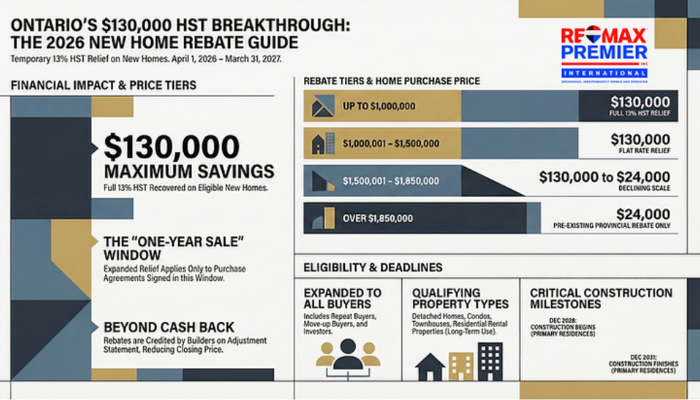
On March 25, 2026, Premier Doug Ford announced that Ontario will temporarily remove the full 13% HST on new home purchases -- and the federal government is on board to cover their share.
For buyers of new construction, this is the most significant tax relief in a generation. Below is everything you need to know, with the details that actually matter at the table.
What Changed and Why It Matters
Under the rules that existed before this announcement, only first-time buyers who planned to live in their new homes were eligible for a rebate on the 13% HST for homes priced up to $1 million, or a partial rebate on units valued up to $1.5 million. That eligibility has now been dramatically expanded. For a one-year period, the province is proposing that the offer be extended to ALL buyers in the province -- not just first-time homebuyers.
The practical result: for new homes valued up to $1 million, Ontario with the support of the federal government would provide up to $130,000 in relief, equivalent to the full 13% HST. However, the most common mistake circulating right now -- including in some builder marketing materials -- is calculating the rebate by simply multiplying the listed purchase price by 13%.
New construction prices are not pre-tax prices. The builder has already factored in the old $24,000 provincial rebate and embedded it into the sticker price. So, the $900,000 you see on the spec sheet is not the base price of the home -- it is the HST-inclusive price, minus the $24,000 that was already being credited.
The correct calculation on a $900,000 listed condo:
|
Step |
Math |
Result |
|
Add back embedded old rebate |
$900,000 + $24,000 |
$924,000 |
|
Back out the true base price |
$924,000 / 1.13 |
~$817,700 |
|
Full 13% HST on base price |
$817,700 x 0.13 |
~$106,300 |
The rebate on a $900K condo is approximately $106,300 -- not $117,000.
This is confirmed by the Ontario 2026 Budget's own illustrative example, which shows a $500,000 purchase carrying total HST of $60,283 (not $65,000), an existing rebate of $24,000, and expected new savings of $36,283.
The Rebate Breakdown by Price Tier
Homes priced between $1 million and $1.5 million will receive a flat $130,000 sales tax reduction, while homes between $1.5 million and $1.85 million will receive a declining tax reduction from $130,000 to the existing $24,000 provincial reduction. Homes valued over $1.85 million will continue to receive the current $24,000 reduction.
|
Purchase Price |
Maximum Rebate |
|
Up to $1,000,000 |
$130,000 (full 13% HST) |
|
$1,000,001 to $1,500,000 |
$130,000 (flat) |
|
$1,500,001 to $1,850,000 |
Declining -- from $130K down to $24K |
|
Over $1,850,000 |
$24,000 (pre-existing Ontario rebate only) |
Who Qualifies?
This is where it gets important. Purchase Agreement must be signed between April 1, 2026 and March 31, 2027. The expanded eligibility includes groups:
Primary Residence Buyers (All Buyers): New homes must be used as a primary residence or as a residential rental property - this means repeat buyers and move-up buyers will now be eligible. Construction must begin on or before December 31, 2028 & construction must be substantially completed on or before December 31, 2031.
Rental Property Investors: Those who purchase homes to use as rental properties could qualify for the tax rebate if construction began before March 31, 2026, and will be substantially completed before December 31, 2029. This is targeted primarily at the existing inventory of unsold pre-construction units -- not future project launches. The conditions are different for new construction starts, so make sure you get proper legal advice on which category you fall into.
Property Types: Any newly built residential property in Ontario qualifies as long as the Purchase Agreement is signed within the eligible window. Detached homes, semis, townhouses, and pre-construction condos all count. Substantially renovated homes are also included.
Who Is Covering the Cost?
The province will cover eight percent (the provincial portion of the HST), while Ottawa will cover the federal portion of five percent. Ontario is paying the full rebate upfront and expects reimbursement from Ottawa once legislation passes.
The Critical Caveat: Legislation Is Not Yet Final
The changes will form part of the upcoming Ontario 2026 Budget but are ultimately subject to passage of federal legislation. Specifically, the federal 5% portion requires amendments to the Excise Tax Act at the federal level. Final legislation, full CRA-administered details, and exact rules around certain situations -- including corporate eligibility, rental treatment, and precise phase-out mechanics -- have not been fully codified at the time of writing.
What this means practically: the program is proceeding and has strong political commitment from both governments, but if you are signing agreements today, you should have your real estate lawyer and accountant confirm eligibility specifics at the time of signing.
The Economic Context
Ontario's contribution to the temporary expansion of HST rebates on new homes would provide almost $1.4 billion in tax relief provincially, with the federal contribution bringing the total to nearly $2.2 billion. The province estimates this measure will stimulate an additional 8,000 housing starts annually, support up to 21,000 jobs, and boost Ontario GDP by $2.7 billion.
Ontario currently builds about 70,000 new homes per year, well below the 175,000 annually needed to reach the province's goal of 1.5 million homes by 2031. This rebate is a demand-side stimulus designed to absorb existing inventory and trigger new construction starts at the same time.
This guide is for general informational purposes and does not constitute legal, financial, or tax advice. Every situation is different — always consult a licensed real estate professional, lawyer, and tax advisor before making any decisions.
Ready to Take the Next Step?
Create your free, secure account at www.VIPCondosToronto.net for full MLS access, real-time sold data, and VIP pre-construction pricing and floor plans — the same tools our team uses every day.
For personalized advice on your specific Toronto buying or selling situation, contact Frank Merigliano and the VIP Condos Toronto team directly:
Phone: 416-885-0172
Email: frank@vipcondostoronto.net
Web: www.VIPCondosToronto.net
Frank Merigliano, Team Leader / Sales Representative, VIP Condos Toronto, RE/MAX PREMIER INTERNATIONAL INC., Brokerage — licensed since 1993, with RE/MAX since 1995, and a Top 50 RE/MAX team in Canada since 2015.
Have questions?
Want to know more about Ontario's New HST Rebate? Send me a message and I'll get back to you within 24 hours.