

What Is a Power of Sale in Ontario?
A power of sale is a legal remedy available to mortgage lenders (mortgagees) in Ontario when a borrower (mortgagor) defaults on their mortgage. Under the Mortgages Act of Ontario, if a borrower falls behind on payments or otherwise breaches the mortgage terms, the lender has the right to sell the property to recover the outstanding debt — without going through the courts. This is different from foreclosure, which is rarely used in Ontario. In a power of sale, the lender sells the property; the homeowner does not receive the proceeds beyond any equity remaining after the debt, costs, and penalties are paid out. If the sale generates more than what is owed, the surplus goes to the borrower. If it generates less, the lender may pursue the borrower for the shortfall.Power of Sale vs. Foreclosure: Key Difference
Power of Sale: The lender sells the property. The borrower retains the right to redeem (pay off the debt) up until closing. The lender must act reasonably and attempt to get fair market value.
Foreclosure: The lender takes full ownership of the property through a court process. Much less common in Ontario. The borrower loses all equity.
Who Is the Seller in a Power of Sale?
This is the most important thing for any buyer to understand: in a power of sale, you are negotiating with the lender, not the homeowner. The lender — typically a bank, trust company, or private mortgage lender — is acting under its mortgage rights. The lender's goal is to recover the outstanding debt, penalties, legal costs, and carrying costs. They are not emotionally attached to the property. They do not know the history of the home the way a longtime owner would. They are not motivated by a new purchase or a life transition — they are motivated by a financial recovery calculation. This has several practical consequences for buyers:Limited disclosure: The lender typically cannot tell you when the roof was last done, whether the basement ever leaked, what renovations were completed, or whether permits were pulled. They simply do not know — and they will say so in the agreement.
As-is condition: Power of sale properties are almost always sold as-is, where-is. The lender will not repair defects, replace appliances, or complete outstanding work before closing.
Lender obligations: Ontario law requires lenders to take reasonable steps to obtain fair market value. Many lenders commission an appraisal before listing so they can demonstrate they acted reasonably if the sale is ever challenged.
The Power of Sale Schedule: Read It Before You Offer
Every power of sale transaction in Ontario includes a power of sale schedule attached to the Agreement of Purchase and Sale. This schedule is not boilerplate — it is, in many ways, the most important document in the deal. These schedules vary significantly from lender to lender. They are not standardized across Ontario. A schedule from one major bank may look completely different from a schedule issued by a private lender or a credit union. Buyers and their agents should never assume they know what a schedule says without reading the specific one in front of them.What the Power of Sale Schedule Typically Covers
Seller's capacity: Confirms the seller is acting as lender/mortgagee under the Mortgages Act, not as a traditional homeowner vendor.
As-is clause: States that the property is sold in its current condition, with no representations or warranties about its state, chattels, fixtures, or systems.
Chattels and fixtures: May limit or eliminate the inclusion of appliances and fixtures — items that would normally be included in a standard resale deal.
Redemption right: Addresses what happens if the borrower pays out the mortgage in full before the transaction closes — the deal may be unwound.
Title matters: May outline what title issues the lender will or will not address on closing.
Conflict clause: Many schedules state that if there is any conflict between the schedule and any other part of the offer, the schedule prevails. This means standard buyer-protective clauses in the main offer may be overridden.
Condition Risk: The Real Concern in Power of Sale
The biggest practical risk in a power of sale purchase is usually not the legal complexity — it's the physical condition of the property. When a homeowner defaults on their mortgage, the circumstances leading to the default often affect the property itself. The home may have been vacant for months. Deferred maintenance may have accumulated. In some cases, upset homeowners have removed fixtures, damaged interiors, or left the property in poor condition. Utilities may have been disconnected, leading to additional problems like frozen pipes or mould.Condition Issues to Watch For
Vacant property damage: Extended vacancy can mean water damage, pest infestations, vandalism, or freeze damage — especially in Ontario winters.
Missing fixtures and chattels: Appliances, light fixtures, HVAC components, or other items may have been removed by the former owners.
Open permits: Unpermitted renovations or open building permits can create issues with title insurance, financing, and future resale.
Insurance: Vacant or distressed properties can be difficult or expensive to insure. Confirm with your insurance broker before firming up.
Financing conditions: Some lenders will not finance properties in poor condition. If you are relying on a mortgage, confirm your lender is comfortable with the property's state before removing your financing condition.
Due Diligence for Power of Sale Buyers in Toronto
Due diligence on a power of sale property requires more attention than a standard resale. Here is what buyers should prioritize:Home inspection: A thorough professional inspection is essential. If the property is in rough shape, consider getting contractor quotes before waiving conditions so you can accurately price any required repairs into your offer.
Legal review: Have your real estate lawyer review the power of sale schedule and the full agreement before submission — not just before the condition deadline. Issues found after you've submitted can be harder to address.
Title search: Power of sale properties can carry title issues including outstanding liens, property tax arrears, construction liens, and other encumbrances. A title search and title insurance are critical.
Property tax arrears: Check whether property taxes are current. Outstanding tax arrears can create complications on closing.
Tenancy: If the property has tenants, Ontario's Residential Tenancies Act applies. Tenants cannot simply be removed because the property sold under power of sale. Get clarity on occupancy status early.
Utilities and systems: If utilities were disconnected, request they be restored before your inspection, or budget for the worst-case scenario.
Negotiating With a Power of Sale Lender
Negotiating a power of sale deal requires a different mindset than negotiating with a homeowner-seller. A homeowner may accept a lower price because they are emotionally ready to move on, need a specific closing date, or are motivated by life circumstances. A lender's decision-making is more formulaic — they are weighing the offer against their outstanding debt, carrying costs, and legal obligations to act reasonably.Tips for Negotiating Power of Sale Properties
Time is your best tool: Lenders are often rigid early in the listing period. If a property sits on market and receives no acceptable offers, the lender becomes more open to negotiation. Patience often works better than aggressive lowballing.
Know the lender's math: The lender needs to recover outstanding principal, arrears, legal costs, and carrying costs. If you can understand approximately what they need to break even, you understand the floor they're likely working with.
Condition-free is powerful: Lenders strongly prefer clean, condition-free offers. If you've done your due diligence and can go firm, this can be a meaningful negotiating advantage — but only go condition-free if you've actually completed your homework.
Don't mistake "power of sale" for automatic discount: If a property is listed publicly and priced at or near market value, other buyers will notice. The discount in a power of sale is usually tied to the property's condition, not the sale type itself.
Closing date flexibility: Lenders generally don't have the same closing date pressures as homeowner-sellers. Offering flexibility on closing may be less of a bargaining chip than it would be in a standard resale.
Is a Power of Sale Property a Good Buy?
Power of sale properties can be excellent buying opportunities — but they are not automatically discounted just because of the sale type. The opportunity is real when the property's condition has suppressed its price below what a well-informed, renovation-capable buyer could achieve after repairs. The risk is real when buyers underestimate the cost of repairs, overlook critical due diligence steps, or assume a standard-offer approach will protect them when the power of sale schedule overrides it. Work with an experienced Toronto real estate agent who has dealt with power of sale transactions before, and retain a real estate lawyer early in the process — before you submit your offer, not after.Power of Sale vs. Standard Resale: Quick Comparison
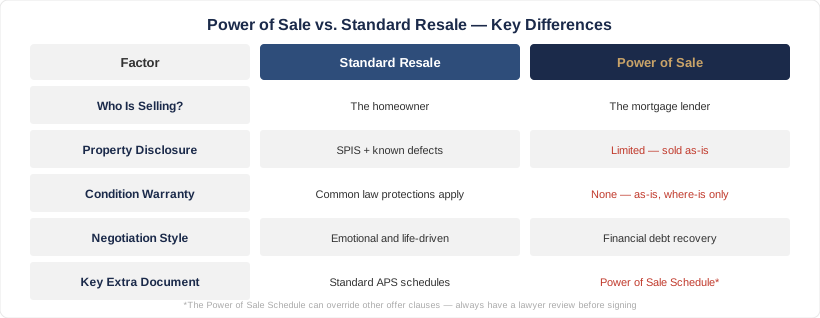
Seller's knowledge of property: In a standard resale, the seller typically has years of knowledge about the home. In a power of sale, the lender often has limited knowledge and cannot make representations about the property's condition or history.
Condition warranties: Standard resales include Seller Property Information Statements (SPIS) and common-law disclosure obligations. Power of sale properties are sold as-is with minimal or no disclosure.
Negotiation style: Emotional and lifestyle-driven in standard resales; financial and debt-recovery driven in power of sale.
Deal complexity: The power of sale schedule adds a layer of legal complexity not present in standard offers. Legal review is more critical.
Risk of deal unwinding: The borrower's right to redeem means the deal can potentially be cancelled before closing if the homeowner pays off the mortgage in full.
This guide is for general informational purposes and does not constitute legal, financial, or tax advice. Power of sale transactions involve significant legal complexity. Always retain a qualified Ontario real estate lawyer and work with an experienced real estate agent before submitting an offer on a power of sale property.
Ready to Take the Next Step?
Create your free, secure account at www.VIPCondosToronto.net for full MLS access, real-time sold data, and VIP pre-construction pricing and floor plans — the same tools our team uses every day.
For personalized advice on your specific Toronto buying or selling situation, contact Frank Merigliano and the VIP Condos Toronto team directly:
Phone: 416-885-0172
Email: frank@vipcondostoronto.net
Web: www.VIPCondosToronto.net
Frank Merigliano, Team Leader / Sales Representative, VIP Condos Toronto, RE/MAX PREMIER INTERNATIONAL INC., Brokerage — licensed since 1993, with RE/MAX since 1995, and a Top 50 RE/MAX team in Canada since 2015.
Have questions?
Want to know more about Power of Sale Properties in Toronto: Complete Buyer's Guide? Send me a message and I'll get back to you within 24 hours.