
Pre-Construction Assignment Sale Guide for Toronto Buyers & Sellers
An assignment sale lets a pre-construction buyer sell their purchase agreement to a new buyer before the building closes or registers — a common but often misunderstood transaction in Toronto's condo market. This guide explains what an assignment sale is, why people do them, how the process works, the tax treatment to be aware of, and the practical risks for both the original purchaser (the assignor) and the new buyer (the assignee).
What Is an Assignment Sale?
When you buy a pre-construction condo or home, you sign an Agreement of Purchase and Sale (APS) with the builder, often years before the building is complete. An assignment sale happens when the original purchaser sells their rights and obligations under that agreement to a new buyer, before the original closing or occupancy date — rather than waiting to take possession themselves and then reselling the completed unit on the resale market.
In effect, the new buyer (the assignee) steps into the original purchaser's (the assignor's) shoes under the existing builder agreement, inheriting the same purchase price, deposit structure, and closing terms that were originally negotiated — plus whatever premium or assignment price is agreed between assignor and assignee.
Why People Sell on Assignment
Life changes: a job relocation, family change, or shift in plans means the buyer no longer wants or needs the unit by the time it's ready to close.
Profit-taking before closing: if the unit's value has risen since the original purchase, some assignors sell to realize a gain without ever taking possession or arranging end financing.
Inability to close: financing conditions, personal circumstances, or qualification issues can make it difficult for the original buyer to complete the purchase at final closing, making an assignment a way to exit the agreement before that point.
How the Assignment Process Works
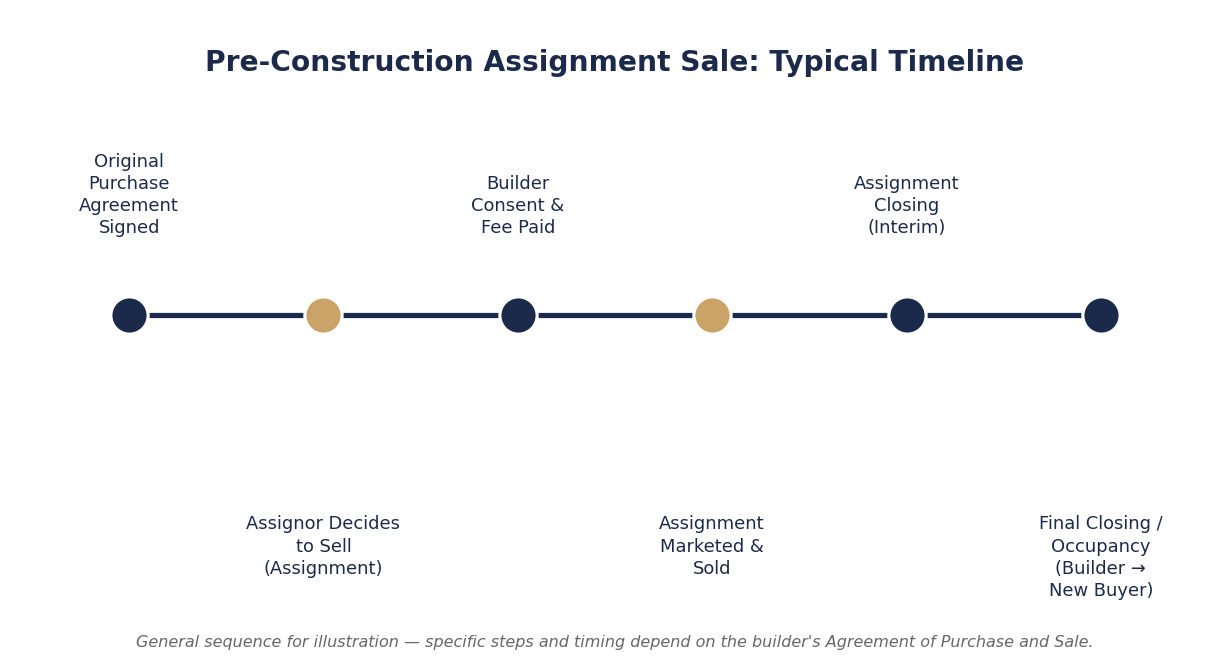
Builder consent is required: virtually all builder agreements require the builder's written consent before an assignment can proceed. The builder may restrict who can market the unit, require its own paperwork, or in some cases reserve a right of first refusal.
Assignment fee: builders typically charge a fee to process and consent to the assignment — this is a cost the assignor should budget for and factor into their net proceeds.
Marketing restrictions: some builders place restrictions on how and where an assignment can be marketed (for example, prohibiting MLS listing or public advertising until certain conditions are met), which can narrow the pool of potential buyers and affect how quickly a sale comes together.
Documentation: an Assignment Agreement is drafted between the assignor and assignee, in addition to the builder's consent documentation, and all three parties' lawyers are typically involved in coordinating the paperwork and closing.
General sequence shown for illustration. Specific steps, fees, and timing depend on the individual builder's Agreement of Purchase and Sale.
Tax Treatment of Assignment Profit
One of the most important — and most overlooked — aspects of an assignment sale is how the profit is taxed. As a general rule, the Canada Revenue Agency tends to treat profit from an assignment sale as business income, not as a capital gain.
Why this matters: business income is fully taxable at your marginal rate, whereas capital gains historically receive more favourable tax treatment with only a portion included in taxable income. Assignors who assume capital gains treatment without confirming it with a tax professional can be significantly underestimating their tax bill.
HST considerations: assignment sales can also have HST implications depending on the structure of the transaction and the assignor's intent at the time of the original purchase, which is another reason this is not a do-it-yourself tax calculation.
This guide provides general background only — assignment tax treatment depends heavily on individual facts and intent. Speak with a tax professional experienced in real estate before entering into or pricing an assignment transaction.
How Deposits and Profit Flow at Closing
At the assignment closing, the new buyer (assignee) typically reimburses the original purchaser for the deposits already paid to the builder, plus pays any additional assignment profit negotiated between the parties. The builder then deals directly with the assignee going forward as the buyer of record, and at final closing/occupancy, the builder transfers the completed unit to the assignee — the original purchaser is no longer part of the transaction at that point.
Risks for Assignment Buyers
Inheriting the original agreement's terms: the assignee is bound by whatever terms the assignor originally negotiated with the builder — including closing dates, deposit structure, and any builder-favourable clauses — which may be less flexible than terms available on a fresh purchase.
Closing cost timing: assignees may face two sets of closing-related costs in quick succession (the assignment closing and the final builder closing), so cash flow planning matters.
Financing can be harder to qualify for: not all lenders are comfortable financing assignment purchases, and the appraisal/financing process can be more complex than a standard resale purchase — start mortgage conversations early.
Risks for Assignment Sellers
Builder consent fees: assignment fees and any other builder-imposed costs reduce the assignor's net proceeds and should be factored into pricing expectations.
Finding a qualified buyer: marketing restrictions and the smaller pool of buyers comfortable with assignment transactions can make it take longer to find a buyer compared to a standard resale listing.
Land transfer tax exposure considerations: depending on how a transaction is structured, there can be land transfer tax considerations affecting both the assignor and assignee — this is a qualitative consideration to flag with your real estate lawyer rather than a fixed dollar figure, since it depends on the specifics of the deal.
Frequently Asked Questions
Do I need the builder's permission to sell my pre-construction unit on assignment?
Yes. Virtually all builder Agreements of Purchase and Sale require written builder consent before an assignment can proceed, often along with a fee and sometimes marketing restrictions.
Is assignment profit taxed the same way as a regular home sale?
Generally, no. The CRA tends to treat profit from assignment sales as business income rather than a capital gain, which is taxed differently and often less favourably. Confirm your specific tax treatment with a tax professional before relying on any assumption.
Why would someone sell on assignment instead of just waiting to close and then reselling?
Common reasons include a change in personal circumstances, wanting to realize a gain without taking on closing costs and ownership, or being unable to complete the purchase at final closing. Each situation is different, which is why working with an experienced assignment-savvy realtor and lawyer matters.
Can any pre-construction buyer find financing for an assignment purchase?
Not always as easily as with a standard resale. Some lenders are less familiar with assignment structures, so it's worth speaking to a mortgage professional early in the process to confirm financing is available before committing to an assignment purchase.
This guide is for general informational purposes and does not constitute legal, financial, or tax advice. Always confirm current rates and rules with a licensed mortgage professional, accountant, or real estate lawyer before making a decision.
Ready to Take the Next Step?
Create your free, secure account at www.VIPCondosToronto.net for full MLS access, real-time sold data, and (where relevant) VIP pre-construction pricing and floor plans — the same tools our team uses every day.
For personalized advice on your specific Toronto buying or selling situation, contact Frank Merigliano and the VIP Condos Toronto team directly:
Phone: 416-885-0172
Email: frank@vipcondostoronto.net
Web: www.VIPCondosToronto.net
Frank Merigliano, Team Leader / Sales Representative, VIP Condos Toronto, RE/MAX PREMIER INTERNATIONAL INC., Brokerage — licensed since 1993, with RE/MAX since 1995, and a Top 50 RE/MAX team in Canada since 2015.
Have questions?
Want to know more about Pre-Construction Assignment Sale Guide for Toronto Buyers & Sellers? Send me a message and I'll get back to you within 24 hours.