
The Complete Resale Home Seller's Guide for Toronto (416)
This resale home seller's guide Toronto edition covers the full selling process for 416-area homeowners — pricing strategy, staging, listing strategy, marketing, negotiating offers, and the closing timeline — along with the real costs of selling and what to know about capital gains tax if the property isn't your principal residence.
Pricing Strategy Basics
Pricing a Toronto resale listing correctly is the single biggest lever you control. List too high and the property sits, developing a stale-listing stigma; list too low (a common offer-date strategy in hot 416 micro-markets) and you risk leaving money on the table if buyer turnout is weaker than expected. A qualified agent will price based on recent comparable sales ("comps") in your specific neighbourhood, current absorption rates, and the condition and finishes of your home relative to those comps — not on what you paid or what you feel it's worth.
In the 416, pricing strategy is also a market-timing decision: a strategic, slightly-under-market list price can generate a wider buyer pool and a competitive offer date, while a closer-to-market price can suit sellers who prefer a single negotiated offer without the uncertainty of a bidding war.
Prepping and Staging (Brief)
Decluttering, depersonalizing, minor repairs, and professional staging consistently help a listing photograph better and show better in person, which tends to translate into stronger offers and a faster sale. Because staging deserves its own deep dive — including room-by-room priorities and DIY vs. professional cost considerations — see our dedicated Home Staging Guide for Toronto Sellers for the full breakdown.
Choosing a Listing Strategy: Offer Date vs. Take-Any-Time
How you structure your listing strategy can materially affect your final sale price, especially in hot 416 micro-markets:
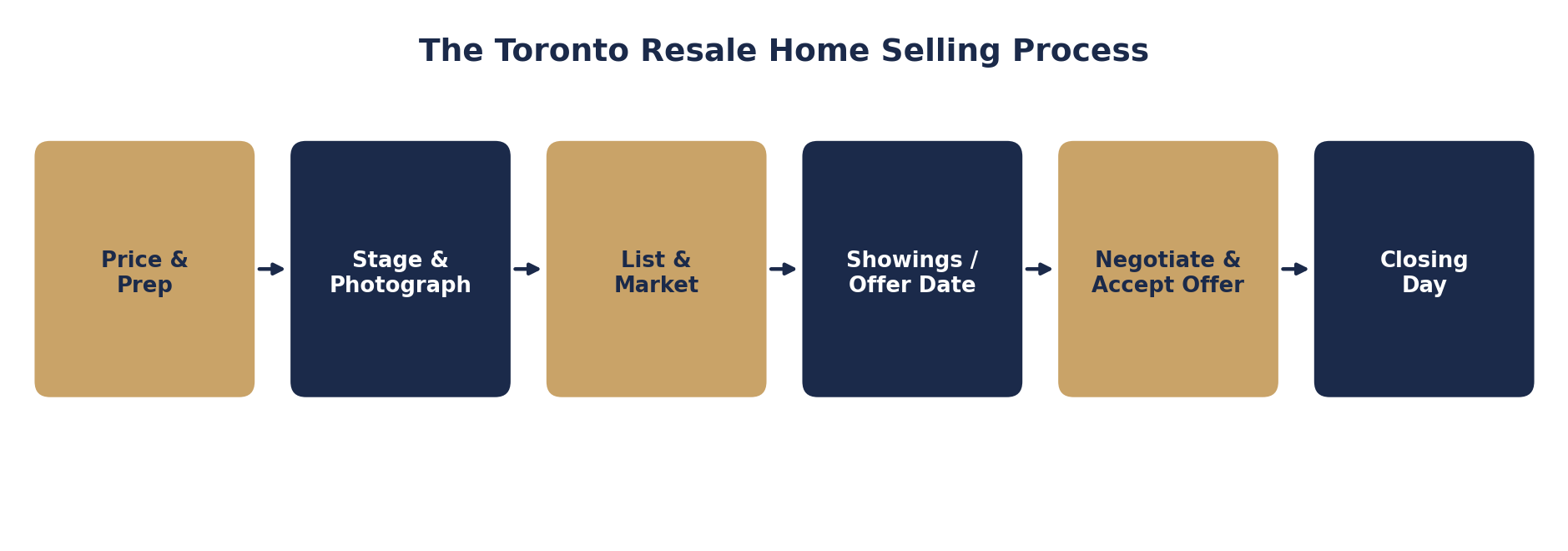
Offer date strategy: the listing is shown for a set number of days, then all offers are reviewed and compared at once on a pre-announced date. This can create competitive tension among multiple buyers, but it isn't guaranteed to produce multiple offers — it works best for desirable, well-priced properties in active micro-markets.
Take-any-time / no offer date: the seller is open to reviewing and negotiating an offer as soon as it comes in, rather than waiting for a set date. This suits unique properties, slower-moving segments, or sellers who want to move quickly on a strong early offer.
Hybrid approach: some 416 listings launch with a soft "book a showing anytime, offers welcome anytime" approach and only set a formal offer date later if buyer interest builds during the first week.
Your agent should base this decision on real-time feedback from showings and buyer-agent inquiries in the first several days on market, not a one-size-fits-all rule.
Marketing a Listing
Effective 416 listing marketing typically includes professional photography, a floor plan, a virtual tour or video walkthrough, syndication to MLS and major listing portals, targeted social media promotion, and (for higher-end or unique properties) an in-person broker open or public open house. The goal is to maximize qualified buyer traffic during the critical first one to two weeks on market, when buyer interest and showing volume are typically highest.
The Closing Timeline and Process
Once you accept an offer, your lawyer takes over the file: ordering a payout statement for your existing mortgage (if any), preparing the deed and closing documents, and coordinating with the buyer's lawyer on the agreed closing date. You'll typically need to vacate and have the property broom-swept by closing, and your lawyer will handle the discharge of your existing mortgage and disbursement of net sale proceeds to you after payout of any liens and closing costs.
Figure 1: The typical resale home selling process for Toronto (416) sellers.
Costs of Selling
Selling a Toronto resale property involves several costs that come off the top of your sale proceeds at closing:
Capital Gains Tax Basics (Non-Principal-Residence Sale)
If the property you're selling is your principal residence, the sale is generally exempt from capital gains tax under the principal residence exemption. If it is not your principal residence — a rental property, a cottage, or a property you didn't designate as your principal residence for the full ownership period — a portion of your gain may be taxable as a capital gain. The rules around what counts as a principal residence, how gains are calculated, and how to report a sale to the CRA are detailed and depend on your personal tax situation, so this section is intentionally general. Speak with an accountant before listing a non-principal-residence property so you understand the tax impact and can plan your closing date and any available elections accordingly.
Negotiating Offers and Multiple Offers
When multiple offers come in, your agent will present them side by side, comparing not just price but also deposit size, conditions (financing, inspection, status certificate review for condos), closing date flexibility, and any included chattels or excluded fixtures. A clean, unconditional offer at a slightly lower price can sometimes be more attractive than a higher offer loaded with conditions, since it carries less risk of falling through. Your agent can also issue a counter-offer or invite a "best and final" round if it's permitted under your specific offer process — and is responsible for presenting all offers to you in full, regardless of which brokerage submitted them.
Frequently Asked Questions
Should I price my home below market value to spark a bidding war?
This is a legitimate strategy in hot 416 micro-markets with an offer-date process, but it isn't guaranteed to work and depends heavily on buyer demand for your specific property type and location. Discuss recent comparable sales with your agent before committing to this approach.
Do I need to stage my home to sell it in Toronto?
Staging isn't legally required, but in a competitive 416 market where buyers compare many online listings before booking a showing, a well-staged and well-photographed listing consistently performs better. See our Home Staging Guide for a full room-by-room breakdown.
What happens to my mortgage when I sell?
Your lawyer requests a payout statement from your lender and discharges the mortgage out of your sale proceeds at closing. If you're breaking a fixed-rate mortgage before its term ends, ask your lender about any prepayment penalty well before listing.
Do I owe tax on the sale of my Toronto home?
If it's your principal residence for the entire period you owned it, the sale is generally exempt from capital gains tax. If it isn't (e.g., a rental or secondary property), a portion of the gain may be taxable — speak with an accountant to understand your specific situation.
This guide is for general informational purposes and does not constitute legal, financial, or tax advice. Always confirm current rates and rules with a licensed mortgage professional, accountant, or real estate lawyer before making a decision.
Ready to Take the Next Step?
Create your free, secure account at www.VIPCondosToronto.net for full MLS access, real-time sold data, and (where relevant) VIP pre-construction pricing and floor plans — the same tools our team uses every day.
For personalized advice on your specific Toronto buying or selling situation, contact Frank Merigliano and the VIP Condos Toronto team directly:
Phone: 416-885-0172
Email: frank@vipcondostoronto.net
Web: www.VIPCondosToronto.net
Frank Merigliano, Team Leader / Sales Representative, VIP Condos Toronto, RE/MAX PREMIER INTERNATIONAL INC., Brokerage — licensed since 1993, with RE/MAX since 1995, and a Top 50 RE/MAX team in Canada since 2015.
Have questions?
Want to know more about The Complete Resale Home Seller's Guide for Toronto (416)? Send me a message and I'll get back to you within 24 hours.