
Toronto 416 Condo Investment & Neighbourhood Selection Guide
Choosing the right neighbourhood is one of the most consequential decisions a condo investor makes in Toronto. This 416 condo investment guide lays out a practical framework for evaluating neighbourhoods, weighing pre-construction against resale, and thinking through financing and exit strategy — without relying on invented numbers you can't verify.
A Framework for Evaluating 416 Neighbourhoods
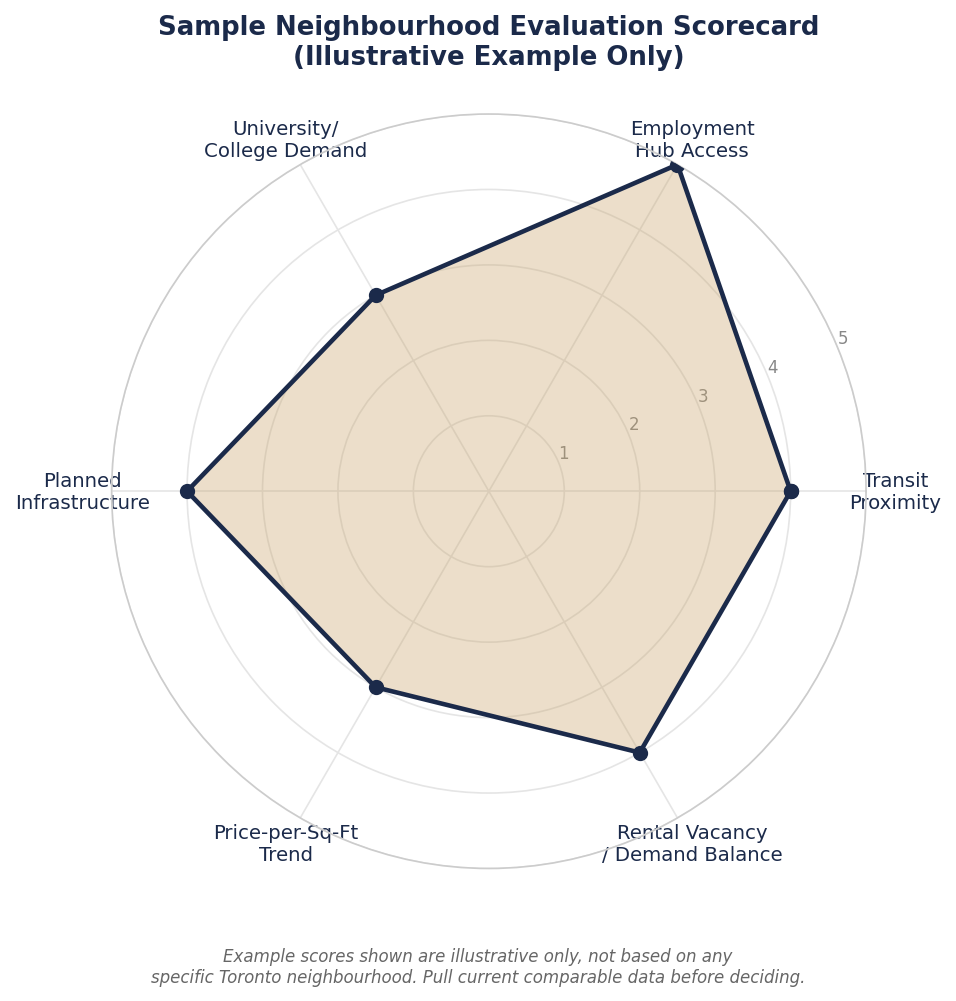
Rather than chasing generic "best neighbourhood" lists, experienced investors evaluate a location against a consistent set of factors. The goal is a repeatable decision process you can apply to any building or neighbourhood under consideration:
Proximity to subway/transit — walking distance to a subway station, GO/UP Express stop, or major transit hub tends to support both resale value and rental demand over time.
Employment hubs — neighbourhoods near the financial core, hospital districts, tech clusters, or other major employment centres tend to draw a steady tenant pool of working professionals.
University/college presence — proximity to a major postsecondary institution can support consistent rental demand from students and faculty, though it also brings seasonal turnover considerations.
Planned infrastructure — transit expansions, new employment developments, or public realm investment can signal future demand growth, though timelines for public projects can shift.
Price-per-square-foot trends — comparing how a building or neighbourhood's price per square foot has moved over time relative to the broader 416 market gives useful context, but requires current, verified data rather than generic blog figures.
Rental vacancy considerations — how quickly comparable units in the building or area have leased historically is a practical proxy for ongoing rental demand strength.
Figure 1: Illustrative example of a neighbourhood scorecard across six evaluation factors. Sample scores shown are for illustration only and are not based on any specific Toronto neighbourhood.
Important: Pull Current Data Before You Decide
We are intentionally not publishing specific cap rates, neighbourhood-by-neighbourhood price figures, or rental yield percentages in this guide. Generic numbers published in blog articles go stale quickly and vary enormously by building, unit type, and timing — using outdated or generic figures to make an investment decision can be worse than having no figures at all.
Instead, before committing to any specific building or neighbourhood, pull current comparable sold and rental data for that exact building or area. VIP Condos Toronto's free MLS access gives clients real-time resale sold data and rental comparables, so you're evaluating a property against what has actually happened recently in that building — not a generalized citywide average.
Pre-Construction vs. Resale Condo Investment Trade-Offs
Both pre-construction and resale condos can fit an investment strategy, but the trade-offs differ meaningfully:
Pre-Construction
Lower initial cash outlay spread over a deposit structure during the construction period, rather than a full down payment at once.
Longer time horizon before the unit is occupiable and generating rental income, with construction and closing timelines that can shift.
Buyer typically locks in today's price for a unit that won't be ready for several years, which can work for or against the investor depending on how the market moves.
Tarion new home warranty protections apply, along with deposit protection rules — see our pre-construction-focused content for full detail on deposit structures and Tarion.
Resale
Immediate possession and rental income potential — no construction timeline risk.
Ability to see the building's actual track record: maintenance fee history, reserve fund health, building management quality, and real comparable sold/rental data.
Typically requires the full down payment and closing costs upfront, with financing underwritten against current, not future, valuations.
Neither path is inherently superior — the right choice depends on the investor's timeline, risk tolerance, and cash flow needs.
Financing Considerations for Investment Condos
Financing an investment condo differs from financing a primary residence in a few important ways to discuss with a mortgage professional:
A minimum 20% down payment is typically required for non-owner-occupied investment properties, compared to lower minimums available for owner-occupied purchases.
Lenders generally allow a portion of the unit's expected or actual rental income to count toward mortgage qualification, but the exact rules (the percentage counted, and how it's calculated) vary by lender.
The mortgage stress test applies to investment property purchases just as it does to owner-occupied purchases.
Because lender policies and qualification rules change, confirm current down payment minimums and rental income qualification treatment with a licensed mortgage professional before finalizing your offer.
Building Type and Unit Selection Within a Building
Once you've narrowed in on a neighbourhood, the same evaluation discipline applies one level down — to the building and unit itself:
Maintenance fee structure and what it covers (utilities, amenities, parking) relative to comparable buildings nearby.
Reserve fund health and any history of special assessments, which can signal future maintenance fee increases or unexpected costs.
Unit layout and floor level — factors like natural light, outdoor space, and proximity to elevators or amenities can meaningfully affect both rentability and resale appeal.
Parking and locker availability, which matters more in some neighbourhoods and tenant profiles than others.
These building-specific and unit-specific factors often matter as much as the neighbourhood-level factors above — a strong neighbourhood with a poorly managed building, or a great building in a less convenient location, can both underperform expectations.
Exit Strategy Considerations
A clear-eyed investor thinks about the exit before buying. Some questions worth asking up front:
Is the plan to hold long-term for rental income and appreciation, or to sell within a defined window (for example, on closing for a pre-construction assignment, or after a multi-year hold)?
How liquid is resale demand likely to be in this specific building and neighbourhood when you eventually want to sell — deeper buyer pools generally mean faster, more predictable sales?
Will future buyers (whether end-users or other investors) value the same features you valued at purchase — transit access, layout, building amenities — or could those features shift in importance over a long hold period?
Revisiting these questions periodically, with current comparable data, helps confirm whether the original investment thesis still holds.
Frequently Asked Questions
What is the most important factor in choosing a condo investment neighbourhood?
There isn't one universal answer — transit proximity, employment hub access, and verified current rental/resale data for the specific building matter more than any single generic factor.
Should I buy pre-construction or resale for investment?
It depends on your timeline and risk tolerance. Pre-construction offers a staged deposit structure and locks in today's price for a future unit; resale offers immediate income and a visible track record.
How much down payment do I need for an investment condo?
A minimum 20% down payment is typical for non-owner-occupied properties, though exact requirements depend on the lender and your overall financial profile.
Where can I get current comparable data instead of generic blog numbers?
A free account at www.VIPCondosToronto.net gives you access to current MLS resale sold data and rental comparables for specific buildings and neighbourhoods.
This guide is for general informational purposes and does not constitute legal, financial, or tax advice. Always confirm current rates and rules with a licensed mortgage professional, accountant, or real estate lawyer before making a decision.
Ready to Take the Next Step?
Create your free, secure account at www.VIPCondosToronto.net for full MLS access, real-time sold data, and (where relevant) VIP pre-construction pricing and floor plans — the same tools our team uses every day.
For personalized advice on your specific Toronto buying or selling situation, contact Frank Merigliano and the VIP Condos Toronto team directly:
Phone: 416-885-0172
Email: frank@vipcondostoronto.net
Web: www.VIPCondosToronto.net
Frank Merigliano, Team Leader / Sales Representative, VIP Condos Toronto, RE/MAX PREMIER INTERNATIONAL INC., Brokerage — licensed since 1993, with RE/MAX since 1995, and a Top 50 RE/MAX team in Canada since 2015.
Have questions?
Want to know more about Toronto 416 Condo Investment & Neighbourhood Selection Guide? Send me a message and I'll get back to you within 24 hours.