
Vacant Home Tax, Underused Housing Tax & Non-Resident Speculation Tax Guide for Toronto (416)
Toronto property owners and investors regularly confuse three separate taxes with overlapping-sounding names: the Toronto Vacant Home Tax, the federal Underused Housing Tax, and the combined Non-Resident Speculation Tax. Each targets a different situation, comes from a different level of government, and has its own rate and declaration requirements. This guide clearly separates the three so 416 owners and investors know exactly which rules apply to them.
Tax #1: Toronto Vacant Home Tax (VHT)
The Vacant Home Tax is a City of Toronto tax that applies to residential properties left unoccupied for an extended period during the year, regardless of who owns them.
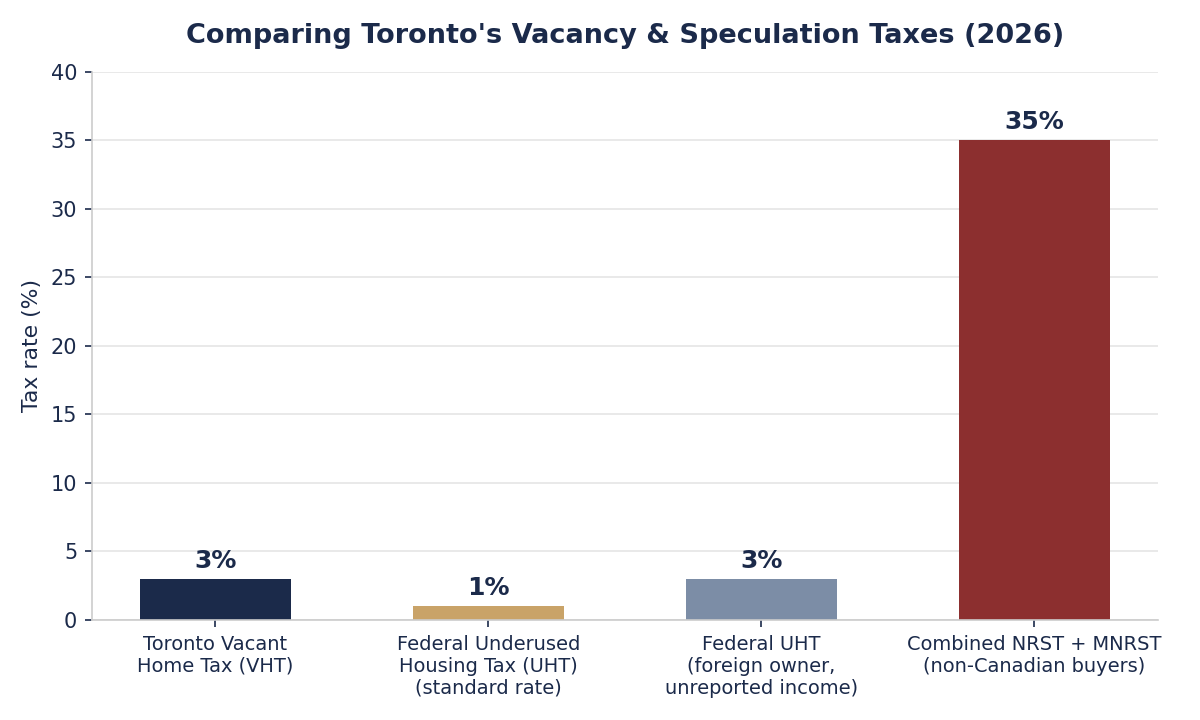
Rate: 3% of the property's Current Value Assessment (CVA) in 2026.
Trigger: applies if a residential property sits vacant for 184 days or more (roughly six months) in the calendar year, without a valid exemption.
Mandatory declaration: every residential property owner in Toronto must file an annual occupancy status declaration — even if the home is occupied as a principal residence or rented out. Failing to declare can result in the property being deemed vacant by default.
Common exemptions: principal residence; tenanted for six months or more in the year; under renovation or construction (with permits); owner deceased; or owner residing in a hospital or long-term care facility, for up to two years.
The VHT applies regardless of the owner's residency or citizenship — a Canadian citizen who leaves a Toronto condo empty is just as subject to it as a non-resident owner.
Owners should treat the annual declaration as a recurring task on their calendar, since the requirement applies every single year, not just once. If your circumstances change — for example, a property that was tenanted becomes vacant, or you move into long-term care — make sure your declaration for that year reflects the correct exemption category, since the City assesses each year independently.
Tax #2: Federal Underused Housing Tax (UHT)
The Underused Housing Tax is a separate, federal tax (not a City of Toronto tax) that targets vacant or underused residential property, primarily aimed at non-resident, non-Canadian owners and certain corporations or partnerships rather than typical Canadian resident homeowners.
Standard rate: 1% annually on the property's value, applied to owners who don't qualify for an exemption.
Who it mainly targets: non-resident, non-Canadian owners, and certain Canadian corporations and partnerships that hold residential property. Most Canadian citizen and permanent resident owners qualify for exemptions and generally won't owe the tax, though many are still required to file a return.
2026 rate increase for unreported foreign income: the rate rises to 3% for foreign owners with unreported Canadian income, starting with the 2026 tax year (up from 2%).
Status: the UHT has not been repealed as of 2026 and remains a federal filing obligation distinct from Toronto's municipal Vacant Home Tax.
Because the UHT is federal and the VHT is municipal, an owner could potentially owe both, owe one but not the other, or be required to file a return for one without owing tax, depending on their residency status, ownership structure, and the property's occupancy.
Tax #3: Non-Resident Speculation Tax (NRST) + Toronto's Municipal Add-On (MNRST)
The Non-Resident Speculation Tax is entirely different from the first two — it is not a vacancy tax. It is a one-time tax applied at the time of purchase, charged to non-Canadian buyers of residential property.
Provincial NRST: 25% of the purchase price, charged to non-Canadian buyers of residential property in Ontario (with limited exemptions and rebates, including for buyers who later obtain permanent residency, or for protected persons/refugees).
Toronto's municipal add-on (MNRST): an additional 10%, in effect since January 1, 2025, that stacks on top of the provincial NRST specifically for purchases within the City of Toronto.
Combined maximum: up to 35% combined speculation tax (25% provincial + 10% municipal) for non-Canadian buyers purchasing residential property in Toronto.
Separate federal foreign buyer ban: on top of the NRST/MNRST, a separate federal prohibition on foreign purchases of Canadian residential property also applies, with its own set of exemptions — distinct from, and in addition to, the provincial and municipal speculation taxes.
The NRST/MNRST is charged at closing on the purchase, unlike the VHT and UHT, which are recurring annual taxes tied to occupancy.
Rates shown reflect verified 2026 figures for each program. Each tax has distinct triggers, exemptions, and filing requirements — see the comparison table below.
Side-by-Side Comparison
Frequently Asked Questions
If I live in my Toronto home full-time, do I still need to do anything?
Yes — you still need to file the annual Vacant Home Tax declaration with the City of Toronto, even though your property qualifies for the principal residence exemption and you won't owe the VHT. Skipping the declaration risks having your property deemed vacant by default.
Can I owe both the Vacant Home Tax and the Underused Housing Tax on the same property?
Potentially, yes. They are independent taxes from different levels of government with different criteria — a non-resident owner with a vacant Toronto property could face both the municipal VHT and the federal UHT in the same year.
Does the Non-Resident Speculation Tax apply every year, like the vacancy taxes?
No. The NRST and Toronto's MNRST are one-time taxes charged at the time of purchase, not recurring annual taxes. The Vacant Home Tax and Underused Housing Tax, by contrast, are assessed annually based on occupancy.
Is the Underused Housing Tax being phased out?
No. As of 2026, the federal UHT remains in effect and is not repealed. In fact, the rate for foreign owners with unreported Canadian income increases to 3% starting with the 2026 tax year.
This guide is for general informational purposes and does not constitute legal, financial, or tax advice. Always confirm current rates and rules with a licensed mortgage professional, accountant, or real estate lawyer before making a decision.
Ready to Take the Next Step?
Create your free, secure account at www.VIPCondosToronto.net for full MLS access, real-time sold data, and (where relevant) VIP pre-construction pricing and floor plans — the same tools our team uses every day.
For personalized advice on your specific Toronto buying or selling situation, contact Frank Merigliano and the VIP Condos Toronto team directly:
Phone: 416-885-0172
Email: frank@vipcondostoronto.net
Web: www.VIPCondosToronto.net
Frank Merigliano, Team Leader / Sales Representative, VIP Condos Toronto, RE/MAX PREMIER INTERNATIONAL INC., Brokerage — licensed since 1993, with RE/MAX since 1995, and a Top 50 RE/MAX team in Canada since 2015.
Have questions?
Want to know more about Vacant Home Tax, Underused Housing Tax & Non-Resident Speculation Tax Guide for Toronto (416)? Send me a message and I'll get back to you within 24 hours.