
The Complete Toronto Landlord Guide: Rental Investment, Tenant Law & LTB Basics (416)
Whether you're buying your first rental condo or managing a portfolio of 416 properties, two things matter equally: understanding why Toronto works as a rental market, and knowing the legal framework that governs every tenancy in Ontario. This guide brings both together — covering the investment case for 416 rental property, Ontario's 2026 rent increase rules, the Residential Tenancies Act, the Landlord and Tenant Board process, lease requirements, cash flow basics, and the practical dos and don'ts every Toronto landlord needs before signing a lease or sending a notice.
Why Investors Buy Rental Property in 416 Specifically
The 416 area code covers the old City of Toronto plus the amalgamated boroughs of Etobicoke, York, North York, East York, and Scarborough — all governed by the City of Toronto's own bylaws (vacant home tax, municipal land transfer tax, multiplex zoning, and the municipal non-resident speculation tax add-on). For landlords and investors, that distinction matters: 416 properties sit closer to subway lines, GO Transit hubs, hospitals, universities, and the downtown employment core than most of the surrounding 905 region.
A few qualitative reasons investors consistently target 416 over the broader GTA:
Liquidity: 416 condos and low-rise homes generally see deeper buyer and tenant pools than outlying 905 markets, which can mean faster lease-up and resale when the time comes.
Long-term appreciation: as one of Canada's largest and most economically diverse cities, Toronto has a long track record of underlying demand pressure tied to population growth, immigration, and limited land supply within the city's boundaries.
Rental demand near transit and employment: tenants — especially young professionals, students, and newcomers — consistently prioritize proximity to subway stations, GO/UP Express connections, and major employment districts (financial core, hospital row, university campuses) over square footage alone.
None of this guarantees outcomes for any specific property — local pricing, building-specific fees, and unit condition all matter — but it explains the durable investor preference for 416 over more distant suburbs.
Ontario's 2026 Rent Increase Guideline
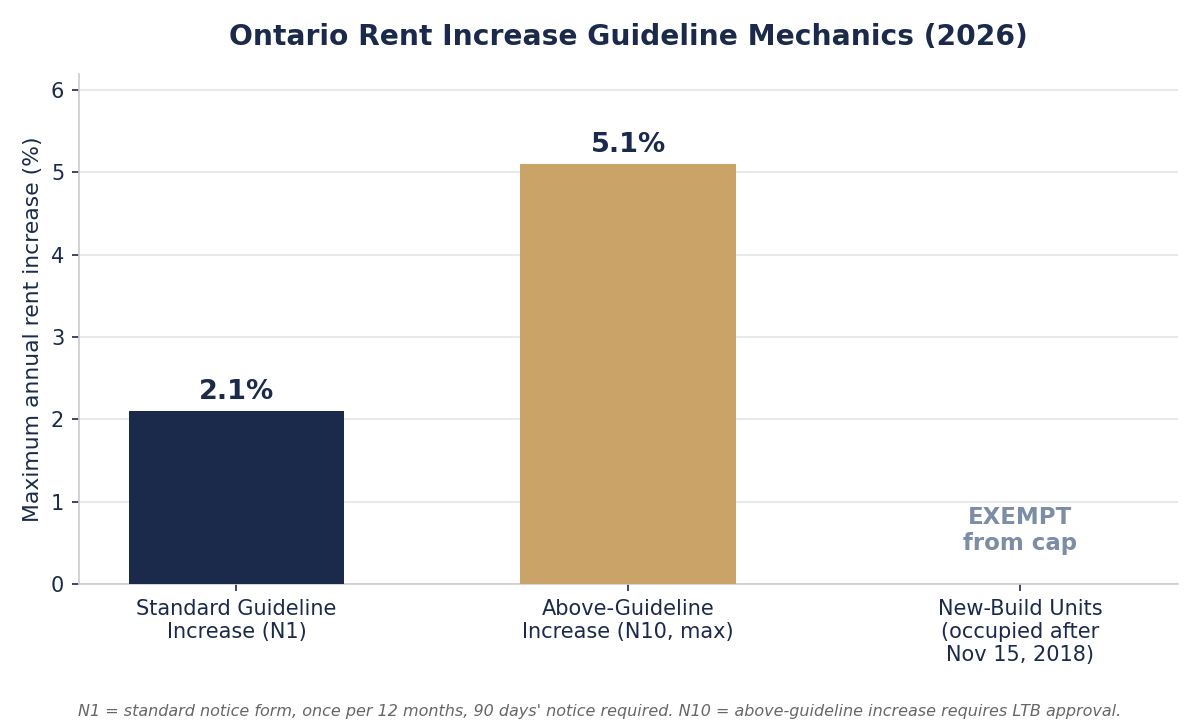
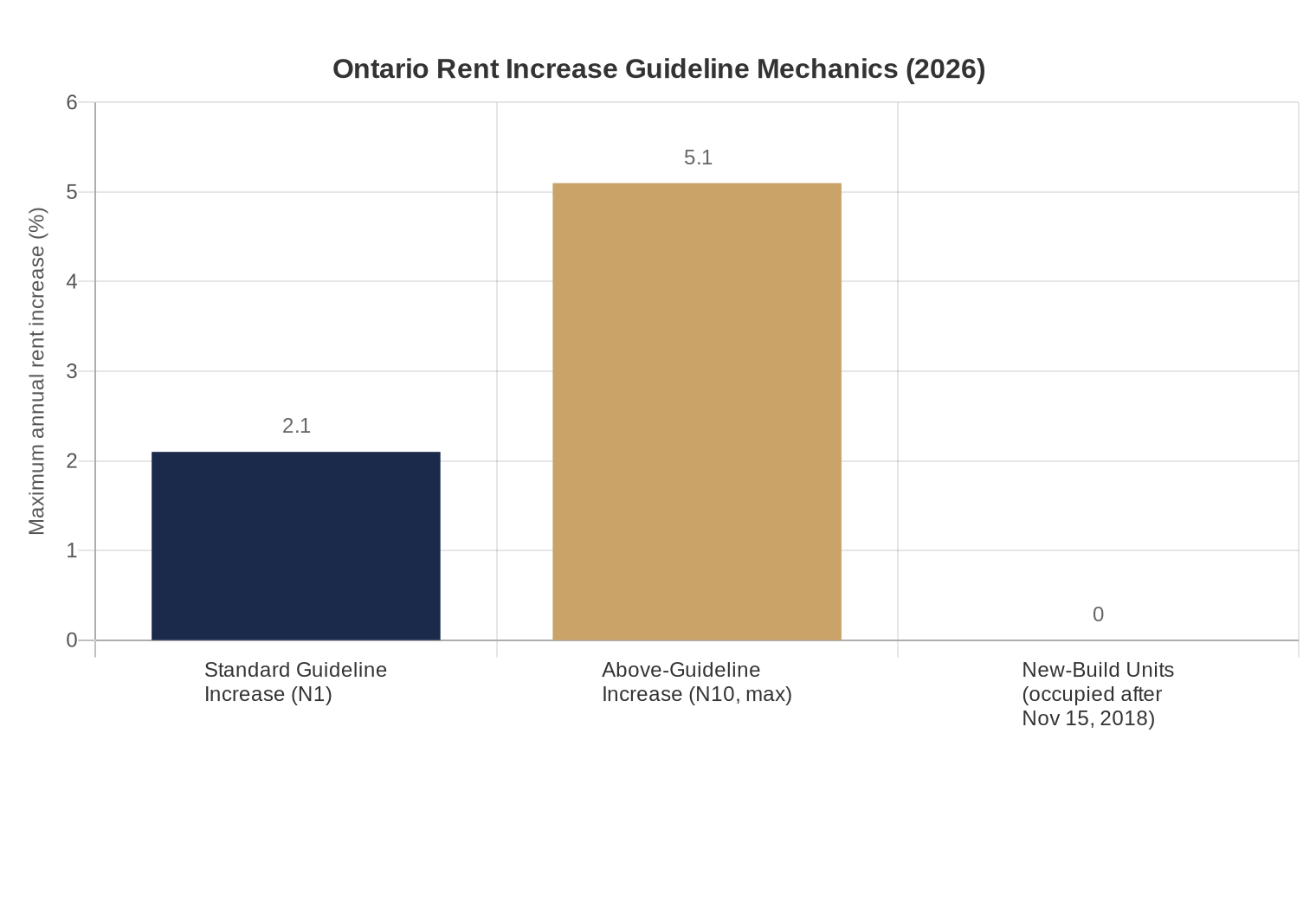
Ontario sets an annual rent increase guideline that caps how much a landlord can raise rent on an existing tenant without seeking approval from the Landlord and Tenant Board (LTB). For 2026, that guideline is 2.1%.
The increase can only be applied once every 12 months for the same tenant.
Landlords must give the tenant 90 days' written notice using the LTB's official N1 form.
The guideline applies to the existing tenant in the unit — it is not something that resets automatically when a lease renews; the 12-month minimum interval still applies.
The New-Build Exemption
Units first occupied for residential use after November 15, 2018 are exempt from the rent increase guideline cap entirely. This was designed to encourage new purpose-built rental supply. If your property qualifies, you are not limited to the 2.1% annual guideline — though any increase still requires proper notice, and tenants can challenge increases they believe are unreasonable through the LTB.
N1 = standard notice form, once per 12 months, 90 days' notice required. N10 = above-guideline increase requires LTB approval.
Figure 1: How Ontario's 2026 rent increase rules compare across standard, above-guideline, and exempt new-build units.
Above-Guideline Increases (N10)
If a landlord's costs have risen significantly — for example, due to a major capital expenditure, a security system, or a municipal tax increase above a set threshold — Ontario allows an above-guideline increase (AGI) through the N10 process. This requires LTB approval, and the increase is capped at the guideline plus 3 percentage points. For 2026, that means a maximum above-guideline increase of 5.1% (2.1% guideline + 3%).
AGIs are not automatic. The landlord must apply to the LTB, provide documentation supporting the cost increase, and the Board decides whether and how much of an increase to approve. This is a more involved process than a standard N1 notice and is best approached with professional guidance.
The Residential Tenancies Act Framework
Most residential tenancies in Ontario are governed by the Residential Tenancies Act (RTA). The RTA sets out the rights and responsibilities of both landlords and tenants — covering rent rules, maintenance obligations, notice requirements, and the process for resolving disputes. It applies broadly to most rented residential units in Toronto, with limited exceptions (for example, certain owner-occupied shared accommodations).
Because the RTA is detailed and the consequences of getting a step wrong can be significant (delayed possession, dismissed applications, or liability for damages), always confirm current details and your specific situation with a paralegal or real estate lawyer before acting.
The Role of the Landlord and Tenant Board (LTB)
The Landlord and Tenant Board is Ontario's tribunal for resolving residential tenancy disputes. Landlords cannot legally remove a tenant, change locks, or otherwise force a tenant out without going through the LTB process — self-help eviction is not legal in Ontario, regardless of the reason for ending the tenancy.
The LTB handles applications for matters such as rent arrears, above-guideline rent increases, landlord's-own-use evictions, and tenant applications related to maintenance or harassment. Decisions are made by an adjudicator after a hearing, and either party can generally request a review or appeal under specific circumstances.
The Standard Lease
Ontario's standard lease form is mandatory for most residential tenancies in the province. Using the correct standard lease form protects both parties by ensuring the lease includes all legally required terms and disclosures. A landlord who fails to use the standard lease when required may face restrictions on enforcing certain lease terms.
Common LTB Forms and Notice Periods
Rent increases and tenancy matters must follow the LTB's prescribed forms and timelines. The table below summarizes the most common forms every Toronto landlord should know:
General notice periods associated with common LTB forms. Exact requirements depend on the specific form and circumstances — confirm with a paralegal or real estate lawyer before issuing any notice.
Ending a Tenancy: Notice Periods and Grounds
Ending a tenancy in Ontario requires using the correct form and following the LTB process — landlords cannot simply ask a tenant to leave informally and expect that to be enforceable.
N4 — Non-Payment of Rent
An N4 notice is used when a tenant has not paid rent. It gives the tenant a notice period to pay the outstanding rent before the landlord can apply to the LTB for an eviction order if the arrears remain unpaid. For N4 notices served on or after September 21, 2026, that notice period is 7 days (previously 14). The process steps are set out in the RTA and LTB rules — given how often these applications turn on procedural detail, working with a paralegal experienced in landlord-tenant matters is strongly recommended.
N12 — Landlord's Own Use
An N12 notice is used when a landlord (or a qualifying family member, or a purchaser in certain circumstances) intends to move into the unit themselves. This form has specific notice period requirements and compensation obligations to the tenant. For N12 notices served on or after September 21, 2026, a landlord who gives at least 120 days' notice for their own or a family member's use no longer has to pay compensation — but that exemption does not apply when a purchaser is moving in. The intended occupant must also move in within 60 days of the termination date, or the LTB will presume bad faith if the former tenant applies. Because N12 applications receive particular scrutiny from the LTB given past concerns about misuse, landlords should approach this process carefully and with professional guidance. See what changed on September 21, 2026 for details.
For any actual eviction or termination process, retain a paralegal or real estate lawyer experienced in landlord-tenant matters — the procedural requirements are detailed, and mistakes can delay or derail an otherwise valid application.
Tenant Screening Basics
Screening prospective tenants is a normal and reasonable part of being a landlord, generally including:
Credit check, with the tenant's consent.
References from previous landlords.
Employment and income verification.
Importantly, screening must stay within the bounds of Ontario's Human Rights Code. Landlords cannot discriminate based on protected grounds such as race, family status, disability, receipt of public assistance, or other protected characteristics. Asking only for information that's relevant to a tenant's ability to pay rent and maintain the unit — and applying the same criteria consistently to every applicant — is the safest approach.
Security Deposits: An Important Rule Most People Get Wrong
Ontario does NOT allow a landlord to collect a general security or damage deposit beyond the last month's rent. Many landlords (and tenants) assume a separate damage deposit is standard, as it is in some other provinces — but in Ontario, the only deposit a landlord can legally require is last month's rent (or, in some cases, first and last month's rent collected at lease signing). Collecting an additional damage deposit on top of that is not permitted under the RTA.
Landlord Obligations at a Glance
Owning a rental property in Toronto comes with ongoing legal and practical responsibilities. The table below summarizes the core obligations every 416 landlord must meet:
Cash Flow Basics: Positive vs. Negative
Before buying a rental property, investors should understand the difference between positive and negative cash flow:
Positive cash flow means the rent collected exceeds all carrying costs — mortgage payment, property tax, condo fees (if applicable), insurance, and a reserve for maintenance and vacancy.
Negative cash flow means the property costs more to carry each month than the rent brings in, with the investor covering the shortfall personally — often in exchange for long-term appreciation and mortgage paydown (principal being built as equity).
Many 416 investment properties — particularly newer condos with higher purchase prices relative to rent — run at or near break-even or modestly negative cash flow in the early years, with investors betting on appreciation and equity growth over time rather than monthly income alone. This is a strategy decision, not a universal rule, and every investor's risk tolerance and financing structure differs.
Mortgage Considerations for Rental Properties
Financing a rental property differs from financing a primary residence in several ways worth discussing with a mortgage professional:
Down payment requirements are typically higher for non-owner-occupied properties than for a primary residence.
Lenders generally use a portion of expected or actual rental income to help qualify the mortgage, but the rules for how much of that income counts vary by lender and loan type.
The mortgage stress test applies to investment property financing just as it does to owner-occupied purchases — qualifying at a rate higher than your actual contract rate.
Multi-unit purpose-built rental properties (5+ units) may be eligible for specialized financing such as CMHC MLI Select — see our dedicated MLI Select guide for Toronto multiplex investors.
Because financing structures and lender requirements change, always confirm current down payment minimums, qualification rules, and rate options with a licensed mortgage professional before making an offer.
Landlord Dos and Don'ts
Frequently Asked Questions
Can I raise rent by more than 2.1% in 2026?
Only through an above-guideline increase (N10) approved by the LTB, capped at 5.1% in 2026, or if the unit was first occupied after November 15, 2018 and is exempt from the guideline entirely.
How often can I increase rent for the same tenant?
Once every 12 months, with at least 90 days' written notice using the N1 form.
Can I evict a tenant myself if they stop paying rent?
No. You must apply to the Landlord and Tenant Board using the N4 notice and process — self-help eviction is not legal in Ontario regardless of the circumstances.
Can I charge a damage deposit in Ontario?
No. Ontario does not allow a general security or damage deposit beyond last month's rent. Collecting one is not permitted under the RTA.
Do new condos automatically qualify for the new-build exemption?
Only if the unit was first occupied for residential purposes after November 15, 2018. Confirm the exact first-occupancy date for your specific unit, as this determines guideline exemption eligibility.
Is negative cash flow a bad investment?
Not necessarily — many investors accept break-even or modestly negative cash flow in exchange for long-term appreciation and equity growth, but this depends on your personal financial situation and risk tolerance.
What can't I ask a prospective tenant during screening?
You cannot ask questions tied to protected human rights grounds — such as family status, disability, or source of income — beyond what is relevant to ability to pay rent and maintain the unit.
Do I need to use Ontario's standard lease form?
Yes. The standard lease form is mandatory for most residential tenancies in Ontario. A landlord who fails to use it may face restrictions on enforcing certain lease terms.
This guide is for general informational purposes and does not constitute legal, financial, or tax advice. Always confirm current rates and rules with a licensed mortgage professional, accountant, or real estate lawyer before making a decision.
Ready to Take the Next Step?
Create your free, secure account at www.VIPCondosToronto.net for full MLS access, real-time sold data, and (where relevant) VIP pre-construction pricing and floor plans — the same tools our team uses every day.
For personalized advice on your specific Toronto buying or selling situation, contact Frank Merigliano and the VIP Condos Toronto team directly:
Phone: 416-885-0172
Email: frank@vipcondostoronto.net
Web: www.VIPCondosToronto.net
Frank Merigliano, Team Leader / Sales Representative, VIP Condos Toronto, RE/MAX PREMIER INTERNATIONAL INC., Brokerage — licensed since 1993, with RE/MAX since 1995, and a Top 50 RE/MAX team in Canada since 2015.
Have questions?
Want to know more about The Complete Toronto Landlord Guide: Rental Investment, Tenant Law & LTB Basics (416)? Send me a message and I'll get back to you within 24 hours.