
When Premier Doug Ford stood at the podium on March 25, 2026 and announced that Ontario would temporarily remove the full 13% HST on new home purchases, it was a political promise — a headline without a rulebook. We covered that announcement in detail at the time in our post Ontario's New HST Rebate.
Four months later, the rulebook has arrived. The CRA published its guidance and regulations in late June 2026, and on July 22, 2026 the Toronto Regional Real Estate Board (TRREB) released a detailed breakdown of how the Enhanced New Housing Rebate (ENHR) will actually operate at the closing table. Combined with what we have learned from real estate lawyers working these files daily — including an excellent seminar by David Young, Partner in Residential Real Estate at SorbaraLAW — we can now walk you through the program from start to finish: where it came from, who qualifies, exactly how the rebate is calculated, and how the money actually reaches you.
The Timeline: How We Got Here
This program did not appear overnight. It is the final piece of a chain of federal and provincial moves that started more than a year earlier:
Date |
What Happened |
March 20, 2025 |
Effective start date for the new federal First-Time Home Buyer (FTHB) GST Rebate — agreements signed on or after this date qualify. |
October 2025 |
Ontario announces its intention to mirror the federal FTHB rebate on the provincial side once the federal legislation passes. |
March 12, 2026 |
Federal Bill C-4 passes into law, eliminating the 5% GST for first-time buyers on new builds up to $1 million (a savings of up to $50,000), with a sliding scale between $1 million and $1.5 million. |
March 25, 2026 |
Premier Ford announces the temporary expanded rebate: up to $130,000 in HST relief for ALL buyers of new homes — not just first-time buyers — for one year. |
March 30, 2026 |
Joint federal-provincial "Partnership to Build Homes, Transit and Communities" press conference confirms Ottawa will fund $875 million of the estimated $2.2 billion cost. Federal Bill C-26, authorizing the payments, begins moving through Parliament. |
April 1, 2026 |
The eligibility window opens — Agreements of Purchase and Sale signed from this date forward can qualify for the enhanced rebate. |
Late June 2026 |
The CRA publishes its guidance and regulations (including Notice 346) — the program moves from political promise to administrative reality. |
July 22, 2026 |
TRREB publishes its detailed explainer on how the Enhanced New Housing Rebate works for purchasers and builders. |
Two Programs — Don't Confuse Them
One of the most important points TRREB makes is that there are now two separate rebate programs running in parallel, with different eligibility windows:
1. The First-Time Home Buyer Rebates (federal + provincial mirror): restricted to first-time buyers, retroactive to agreements signed on or after March 20, 2025, and running to the end of 2030. Construction must begin before 2031 and be substantially completed before 2036.
2. The Enhanced New Housing Rebate (the "all buyers" program): open to all eligible purchasers — including repeat buyers, move-up buyers, and residential investors — but only for Agreements of Purchase and Sale entered into between April 1, 2026 and March 31, 2027.
Which program applies to you depends on when you signed and whether you are a first-time buyer. If you fall into both windows, get professional advice on which route delivers more relief — the answer depends on your price point.
The Rebate by Price Tier
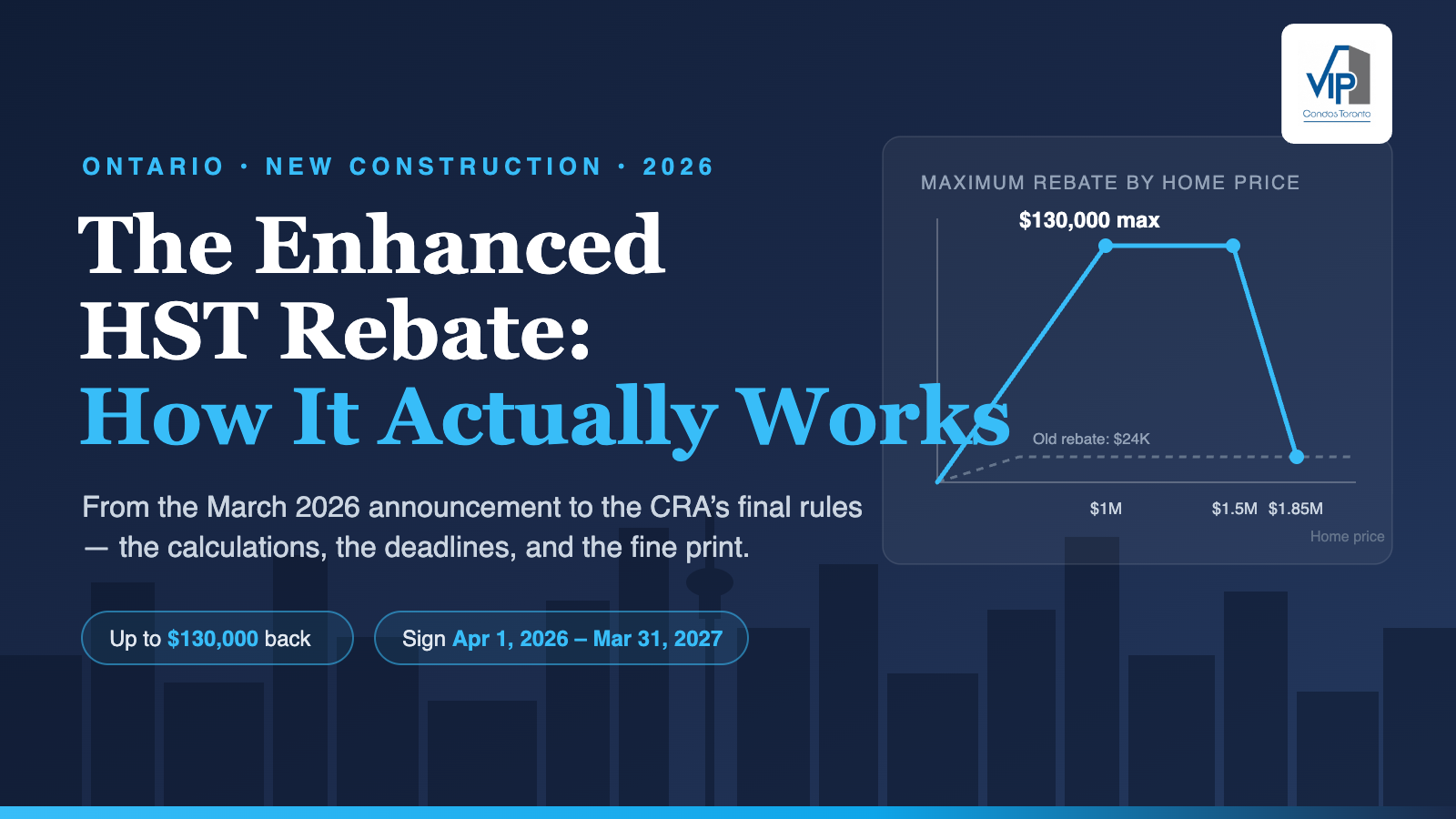
Per TRREB and the CRA's Notice 346, the enhanced rebate combines 100% of the 8% provincial portion of the HST (up to $80,000) with a federal top-up (up to $50,000) for a combined maximum of $130,000:
Home Value |
Enhanced Rebate |
Up to $1,000,000 |
Full 13% HST relief — up to $130,000 |
$1,000,001 – $1,500,000 |
Flat $130,000 (not all of the 13% HST is rebated) |
$1,500,001 – $1,850,000 |
Declines in a straight line from $130,000 down to $24,000 as the value rises |
Over $1,850,000 |
Not eligible for the enhanced program — the pre-existing "legacy" $24,000 Ontario rebate still applies |
How to Calculate It Properly: The Sticker Price Trap
As we flagged in our original post, the single most common mistake — still circulating in some builder marketing — is multiplying the listed purchase price by 13%. New construction sticker prices are not pre-tax prices. The builder has already embedded the HST and credited the legacy $24,000 rebate into the number you see on the spec sheet. To find the true rebate, you must first back out the real base price of the home.
This method is confirmed by the Ontario 2026 Budget's own illustrative example: a $500,000 purchase carries total HST of $60,283 — not $65,000 — because the true base price is ($500,000 + $24,000) ÷ 1.13 = $463,717, and 13% of that is $60,283. The government's expected new savings of $36,283 is exactly that HST less the $24,000 already credited.
The worked examples below follow the methodology presented by David Young of SorbaraLAW.
Example 1 — $1,200,000 purchase (inclusive of 13% HST), signed between April 1, 2026 and March 31, 2027, builder handling the rebates
Step |
Amount |
Net (base) price — back out the full 13% HST ($1,200,000 ÷ 1.13) |
$1,061,946.90 |
Full 13% HST on the base price |
$138,053.10 |
Enhanced rebate (base price is in the $1M–$1.5M band, so the maximum cap applies) |
–$130,000.00 |
Net HST payable |
$8,053.10 |
Effective purchase price with rebate deducted |
$1,070,000 |
The buyer does not escape HST entirely — but the capped $130,000 rebate takes $130,000 off what would otherwise be owed.
Example 2 — $1,700,000 purchase (inside the phase-out zone), same window
Step |
Amount |
Net (base) price ($1,700,000 ÷ 1.13) |
$1,504,424.78 |
Full 13% HST |
$195,575.22 |
Enhanced rebate (pro-rated — Ontario's own chart shows approximately $69,500 for a $1.7M home) |
–$69,500.00 (approx.) |
Net HST payable |
$126,075.22 |
Effective purchase price with rebate deducted |
$1,630,500 |
A note on purchases near the thresholds: the phase-out is keyed to the home's value, and Ontario's published chart maps a $1.7 million home to roughly $69,500. However, the CRA's public guidance does not yet spell out whether the $1.5M and $1.85M lines are measured against the pre-tax base price or the all-in purchase price — and for a purchase near a threshold, that distinction can swing the rebate by tens of thousands of dollars. If your deal sits anywhere close to $1.5M or $1.85M, have your real estate lawyer confirm the exact calculation against the CRA rules before you rely on a number.
Example 3 — $1,850,000 purchase (top of the range)
At this price point only the legacy rebate remains. Base price of $1,637,168.14, full HST of $212,831.86, less the $24,000 legacy rebate = net HST payable of $188,831.86, for an effective price of $1,826,000. Above $1.85 million, nothing changes from the old rules.
What If You Signed Before April 1, 2026 as a First-Time Buyer?
First-time buyers who signed on or after March 20, 2025 are not left out — they fall under the FTHB program instead. SorbaraLAW's worked example: on a $700,000 sticker-price home, the true base price is $640,707.96 and the full 13% HST is $83,292.04 (made up of $32,035.40 federal GST and $51,256.64 provincial PST). The buyer ultimately claims three rebates — the legacy $24,000 already embedded in the sticker price, the new federal FTHB GST rebate of $32,035.40, and the provincial FTHB rebate of $27,256.64 (the PST less the legacy $24,000 already accounted for) — for $83,292.04 in total tax relief: the entire HST.
On a $1,200,000 FTHB purchase, the sliding scale applies and the combined relief comes to approximately $108,371.69 of the $140,814.16 owing.
A status note on the two FTHB pieces: the federal FTHB GST rebate is law (Bill C-4, passed March 12, 2026) and can be claimed now. The provincial FTHB mirror has been announced with the same eligibility dates, but its enabling rules were still being finalized at the time of writing — before counting on the provincial portion, have your real estate lawyer confirm its status at filing time.
How You Actually Receive the Money
This is where the TRREB explainer is most valuable, because the mechanics differ depending on your agreement. Per TRREB, for agreements signed in the April 1, 2026 – March 31, 2027 window, eligible buyers can receive the rebate credited directly at closing — it reduces the balance you owe on the Final Statement of Adjustments rather than requiring you to pay first and wait for a refund. Here is how it works behind the scenes:
For purchasers: you assign your rebates to the builder and complete the GST/HST New Housing Rebate application (Form GST190) together with the Ontario schedule (Form RC7190-ON). The builder submits the application to the CRA on your behalf.
For builders: the builder credits you up to $130,000 at closing, reports the full HST collected on its regular GST/HST return, and claims a deduction for the 8% provincial portion through the CRA. The CRA shares eligibility data with the Ontario Ministry of Finance, which then reimburses the builder for the 5% federal top-up — within 30 days when filed electronically.
There are three practical scenarios, as laid out by SorbaraLAW:
Your Situation |
What Happens |
APS signed after March 20, 2025 and before March 31, 2026 (FTHB) |
You pay the sticker price under the legacy program and apply to the CRA yourself after closing — Form GST190 for the federal portion and Form RC7190-ON for the provincial portion. The CRA recommends filing online for faster response times. |
APS signed on/after April 1, 2026 with a clause stating the builder will handle the rebates |
You receive the benefit directly on closing with a reduced balance owing on the Final Statement of Adjustments. No CRA application, no waiting months for a refund. |
APS signed on/after April 1, 2026 without such a clause |
You pay the full amount on closing and apply to the CRA for the funds afterward. |
The takeaway: the rebate clause in your APS matters enormously. Whether you get $130,000 credited at closing or have to front that money and claim it back later comes down to how your agreement is drafted — have your lawyer review it before you sign.
Who Qualifies — and Who Doesn't
TRREB confirms the enhanced program follows the existing eligibility rules for Ontario's New Housing Rebate: you must be an eligible individual purchasing a new or substantially renovated home from a builder, and the home must be intended as the primary place of residence for you or a relation — or used as a residential rental property.
End users (primary residence): construction must begin on or before December 31, 2028 and be substantially completed on or before December 31, 2031.
Investors (residential rental): yes, investors qualify — but the conditions are tighter. Construction must have begun on or before March 31, 2026 and be substantially completed on or before December 31, 2029. This is deliberately aimed at moving the existing inventory of unsold pre-construction units, not future launches.
And just as important — the situations that don't work, per the anti-avoidance rules highlighted by SorbaraLAW:
Signed years ago, closing now?
No. If your APS pre-dates the eligibility windows — even if your home has not yet closed — these new rebates do not apply to you. The programs are strictly forward-looking.
Cancel your old APS and re-sign after April 1, 2026?
No. Federal anti-avoidance measures — which the province mirrors — disallow the rebate where an original agreement was cancelled and replaced with a new one for the same property. These rules exist precisely to prevent gaming of the system.
Buy an assignment after April 1, 2026?
No. The CRA bases eligibility on the date the original agreement was signed between the builder and the first purchaser. Taking over a contract by assignment does not reset the clock.
The Bottom Line
What was a headline in March is now a functioning program with CRA forms, filing mechanics, and firm deadlines. For buyers of new construction who sign between April 1, 2026 and March 31, 2027, this is the deepest tax relief on new homes in a generation — up to $130,000, potentially credited right on your Statement of Adjustments. But the details decide everything: the price tier you land in, the date on your APS, the rebate clause in your agreement, and whether you are an end user or an investor.
Official CRA Resources
For readers who want to go straight to the source, the CRA has published dedicated guidance on the enhanced rebate (as compiled by TRREB):
CRA Notice 346 — Ontario Enhanced New Housing Rebate: the CRA's core notice on the enhanced rebate, including eligibility conditions and the rebate tiers.
Ontario Temporary Enhanced New Housing Rebate — Homes Purchased from a Builder: the CRA's guidance for the most common scenario, buying a new or substantially renovated home directly from a builder.
GST/HST New Housing Rebate — Overview: the CRA's main hub for all new housing rebate programs, federal and provincial.
Guide RC4028 — GST/HST New Housing Rebate: the CRA's detailed guide covering the application process, including Form GST190 and the Ontario schedule RC7190-ON.
This guide is for general informational purposes and does not constitute legal, financial, or tax advice. Every situation is different — always consult a licensed real estate professional, lawyer, and tax advisor before making any decisions.
Ready to Take the Next Step?
Create your free, secure account at www.VIPCondosToronto.net for full MLS access, real-time sold data, and VIP pre-construction pricing and floor plans — the same tools our team uses every day.
For personalized advice on your specific Toronto buying or selling situation, contact Frank Merigliano and the VIP Condos Toronto team directly:
Phone: 416-885-0172
Email: frank@vipcondostoronto.net
Web: www.VIPCondosToronto.net
Frank Merigliano, Team Leader / Sales Representative, VIP Condos Toronto, RE/MAX PREMIER INTERNATIONAL INC., Brokerage — licensed since 1993, with RE/MAX since 1995, and a Top 50 RE/MAX team in Canada since 2015.
Sources: TRREB — Ontario Enhanced New Housing Rebate (July 22, 2026); "New HST Rebates" seminar by David Young, Partner, Residential Real Estate, Sorbara, Schumacher, McCann LLP (April 16, 2026); Ontario 2026 Budget — HST relief for new homes; our original coverage of the March 25, 2026 announcement.
Have questions?
Want to know more about Ontario's Enhanced HST Rebate: From Announcement to Reality — How It Actually Works? Send me a message and I'll get back to you within 24 hours.